
By MES Dispatch Staff
The Briefing
- • Momentum Aeronautics, a St. Paul, Minnesota-based aviation engineering firm, received Federal Aviation Administration clearance in late 2025 for its aerial firefighting float system, commercially named “Heatwave,” which is designed to make water-scooping operations safer for firefighting aircraft pilots.
- • The system attaches to single-engine Air Tractor aircraft and allows pilots to skim the surface of lakes to fill an 800-gallon water tank — a method that can yield up to 25 water drops per hour, compared to approximately two per hour for land-based tanker aircraft.
- • Water-scooping aerial firefighting operations carry significant risk; several aircraft crash each year during scooping runs due to wave impacts, premature takeoff, and unstable flight characteristics during water contact.
- • Momentum Aeronautics is delivering five systems in 2026 and projects annual production of 12 or more by 2028; Florida-based Coastal Air Strike is among the contractors currently using the Heatwave system, with pilots stationed in Hibbing and Brainerd, Minnesota.
- • The development comes as Minnesota state officials forecast elevated wildfire risk and up to 16 days of poor air quality from wildfire smoke for summer 2026, following two wildfires in mid-May that burned approximately 2,000 acres combined and destroyed several homes.
ST. PAUL, Minn. — A St. Paul aviation engineering firm has received Federal Aviation Administration clearance for a newly developed float system designed to make aerial water-scooping operations safer for wildfire pilots — a technology that could improve response efficiency in lake-dense regions where aircraft-based firefighting plays a critical role in early containment efforts.
Momentum Aeronautics, founded and led by Dan Garrett, began developing the system more than five years ago with the goal of reducing the well-documented risks of water-scooping aerial firefighting. Pilots flying these missions skim the surface of lakes to fill onboard tanks — a procedure that carries inherent dangers including wave strikes that can flip or sink aircraft, stall-induced crashes from premature takeoff, and unstable flight characteristics during water contact. Several such aircraft crash nationally each year. The company received FAA clearance for its completed product, marketed as Heatwave, in late 2025.
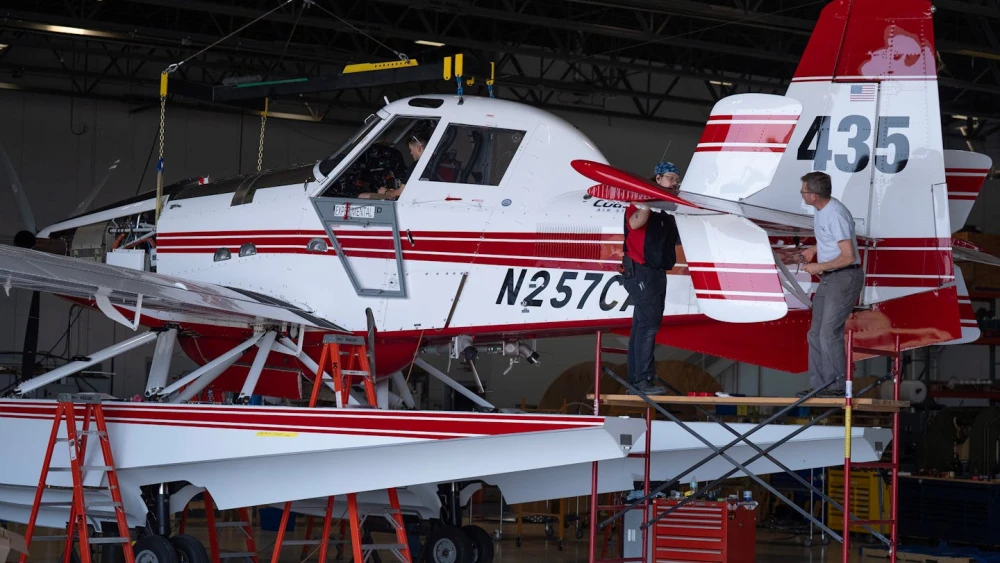
The Heatwave system consists of a specialized pair of floats that attach to single-engine Air Tractor model aircraft — a platform widely used in crop dusting, firefighting, and fuel transport operations. The floats draw water into an 800-gallon onboard tank while the aircraft skims the water surface at controlled speed. Garrett said the float design substantially reduces the tendency of the aircraft to pitch and bounce during the scooping run, which company-trained pilot Colby Smith of Coastal Air Strike described as a significant improvement in controllability compared to prior equipment. Smith said five pilots were trained on the new system in 2026.
The efficiency advantage of water-scooping aircraft over their land-based counterparts is considerable: Garrett said scooping-equipped aircraft can complete up to 25 water drops per hour, compared to approximately two per hour for planes that must return to a land base to refill. He noted, however, that the technology is best suited to regions with accessible bodies of water and is less applicable in arid environments. Garrett said the company’s primary market comes from government contracts with private aerial firefighting operators. Momentum Aeronautics is delivering five Heatwave systems in 2026 and projects annual output of 12 or more by 2028.
The system’s commercial launch comes as wildfire conditions in Minnesota are projected to be elevated through summer 2026. State officials forecast warm, dry conditions, up to 16 days of poor air quality attributable to wildfire smoke, and some heightened fire risk. Two wildfires — the Stewart Trail and Flanders fires — burned a combined approximately 2,000 acres and destroyed several homes in Minnesota in mid-May. The Minnesota Interagency Fire Center, which coordinates federal and state aerial firefighting resources, described water-scooping aircraft as a highly agile and frequently utilized tool during the initial attack phase of wildfire response, complementing larger assets such as bucket-carrying helicopters and Canadair CL-415 super scoopers.