
By MES Dispatch Staff
The Briefing
- New Mexico’s more than 40 volunteer search and rescue teams are being deployed less frequently despite a rising number of incidents requiring rescue services, with response rates declining from 76% in 2023 to 40% as of mid-June 2026.
- Resource Officer Bob Rodgers cited cases where county sheriffs and local law enforcement agencies delayed requesting SAR assistance by hours or days, waiting until initial search efforts proved unsuccessful before calling in specialized teams.
- Air Force Major General William McCasland disappeared from his Albuquerque home in late February; Bernalillo County Sheriff’s Office did not request SAR assistance until two days after his overdue report, and McCasland remains missing.
- A 2025 amendment to the state Search and Rescue Act requiring first responders to notify state police when incidents involve “lost, stranded, entrapped or injured persons” took effect in 2026 but has not increased SAR deployment.
- Volunteer leaders stated that SAR teams provide specialized expertise in advanced land navigation, wilderness survival, and technical rope rescue that local law enforcement typically lack, while keeping costs to the state minimal at approximately $200 per mission.
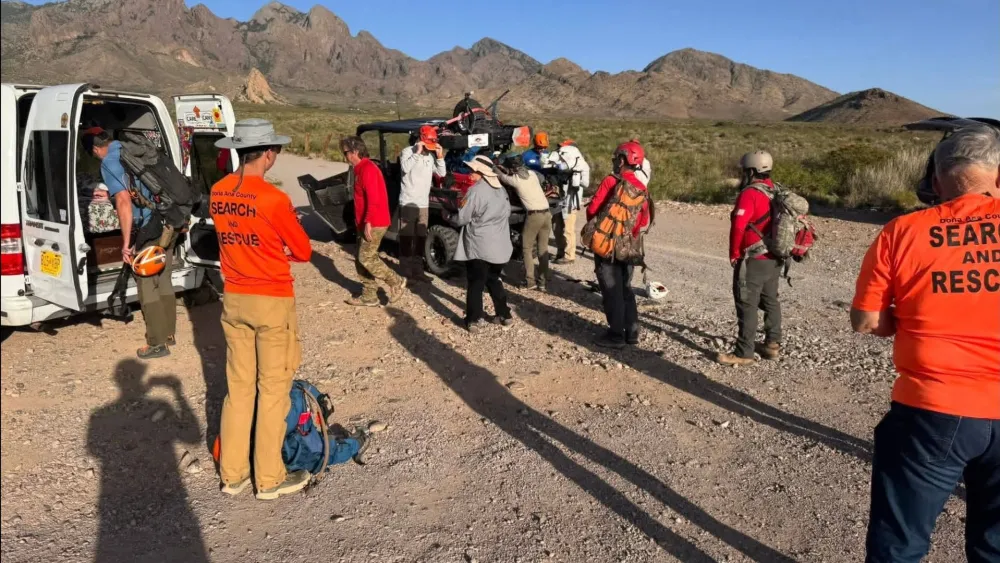
ALBUQUERQUE, N.M. — New Mexico’s volunteer search and rescue teams continue to be called to fewer operations despite rising incident frequencies, prompting SAR leaders to attribute the decline to reluctance among county sheriffs and local law enforcement to request state assistance.
Bob Rodgers, resource officer for New Mexico Search and Rescue since 2011, documented response data showing a sharp decline in SAR deployment. In 2023, volunteer teams responded to 76% of 149 incidents. By 2024, response rates fell to 50% of 187 incidents. The 2025 rate recovered slightly to 55% of 191 incidents, but declined to 40% of 75 incidents as of June 10, 2026.
“Throughout the state of New Mexico, the volunteers are being called less and less to participate in search and rescue incidents,” Rodgers stated. “Fire departments, county sheriffs, feel they can do it without us, and if they get into a problem, they’re waiting two or three hours, if not days, before they finally realize they needed SAR.”
As the law enforcement arm of the Department of Public Safety, New Mexico State Police possess authority to deploy search and rescue teams. However, county and local law enforcement agencies—typically first responders—often choose not to request state assistance, according to Rodgers.
He cited the case of retired Air Force Major General William McCasland, who disappeared from his Albuquerque residence in late February. The Bernalillo County Sheriff’s Office did not request search and rescue assistance until two days after his report was overdue. McCasland has not been located.
Rodgers stated that delays in mobilizing appropriate resources for missing person searches significantly reduce successful outcome chances.
Similar patterns emerged elsewhere in the state. In March, Taos Search and Rescue President Delinda VanneBrightyn reported that the Taos County Sheriff’s Office delayed contacting the Department of Public Safety to dispatch volunteers after two teenagers became trapped at the bottom of Rio Grande Gorge. VanneBrightyn stated the organization “had a very hard time getting search and rescue involved.”
Taos County Sheriff Steve Miera was unavailable for comment. Previously, he stated intentions to train deputies in search and rescue techniques. For years, his staff has overseen responses at Rio Grande Gorge Bridge, the site of numerous suicides and missing person cases.
VanneBrightyn, a volunteer for more than 20 years specializing in K-9 search and rescue, emphasized that law enforcement benefits from SAR’s specialized expertise. “We should be having many more missions,” she stated. “The sheriffs are now doing this across the state.”
A 2025 amendment to the state Search and Rescue Act requiring first responders to notify state police when incidents involve “lost, stranded, entrapped or injured persons” took effect in 2026. However, state data suggests volunteer teams remain underutilized in 2026.
Declining mission numbers have prompted volunteer team membership losses as volunteers find training hours rarely translate into operational deployment.
VanneBrightyn expressed frustration with the situation. “It has been frustrating because the sheriff doesn’t have the resources, the trained resources that we have. They are law enforcement.”
The decline in New Mexico search and rescue missions dates to 1996, when 191 missions involved 4,004 personnel and 22,602 field hours, according to records. Rodgers noted that older state data reliability is less certain than more recent records.
Grant County Search and Rescue President Russ Imler suggested that declining missions may relate to advanced wayfinding technologies, including GPS devices and smartphones. “The electronics that people carry nowadays, people aren’t getting as lost,” Imler stated.
Rodgers emphasized the cost-effectiveness and specialized capabilities SAR teams provide. Teams possess advanced land navigation, wilderness survival, and technical rope rescue expertise law enforcement agencies typically lack. SAR operations cost approximately $200 per mission—expenses covering logistics only, without salary, overtime, or food costs. Rodgers stated a 30-person team can operate autonomously for 24 hours without external support.