
By MES Dispatch Staff
The Briefing
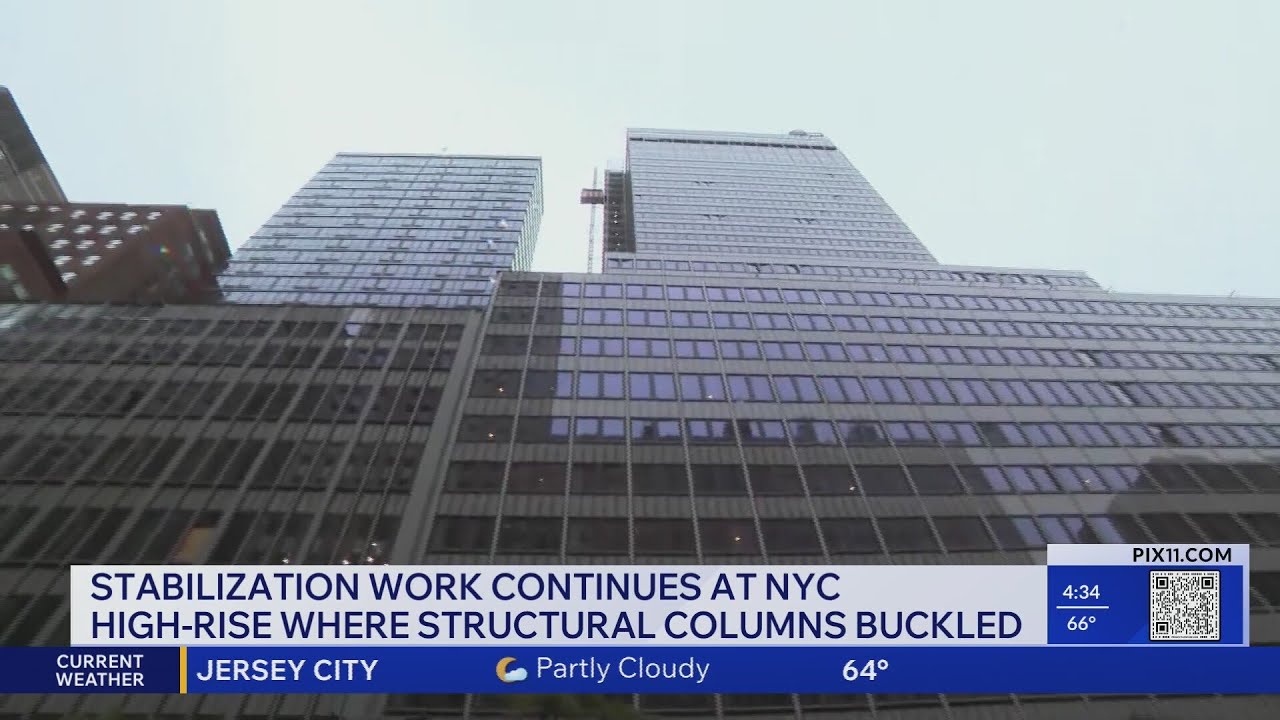
- A 37-story Manhattan office tower undergoing conversion to luxury apartments at 235 East 42nd Street was stabilized Tuesday evening after structural columns buckled on the 21st and 22nd floors, prompting emergency evacuations of seven nearby buildings.
- New York City Department of Buildings Commissioner Ahmed Tigani confirmed that intensive monitoring detected no additional movement of the damaged columns after multiple floors were assessed.
- The former Pfizer global headquarters building experienced sagging floors and multiple cracks; developer MetroLoft attributed the damage to added weight from construction widening the top approximately 15 floors.
- Structural engineers stated the two buckled columns will require removal and replacement rather than repair, with shoring systems installed as emergency temporary support while repairs proceed.
- The building remained evacuated during much of Tuesday while emergency personnel conducted structural assessments; the project is characterized as the largest office-to-residential conversion in New York City history with over 1,600 planned units.
MANHATTAN, N.Y. — A major office-to-residential conversion project stabilized its structure Tuesday after discovering buckled columns that prompted widespread evacuations and concerns of potential collapse. By evening, most nearby buildings were permitted to reoccupy.
The building at 235 East 42nd Street, the former global headquarters of pharmaceutical manufacturer Pfizer, experienced structural failure when two load-bearing columns buckled on the 21st and 22nd floors. The incident prompted immediate evacuation of seven nearby buildings, including a school, the Israeli consulate, and several hotels in the midtown corridor near Grand Central Terminal and the Chrysler Building.
Fire Department personnel responded around 8 a.m. Tuesday and documented structural damage including bent columns visible through large glass windows on the 21st floor, multiple cracks, and sagging floors between the 21st and 26th levels.
Ahmed Tigani, commissioner of the New York City Department of Buildings, held a press conference Tuesday evening and confirmed that intensive monitoring and floor-by-floor inspections throughout the day detected no additional movement in the damaged columns. “We’ve been monitoring the building for many hours and have not seen any movement,” Tigani stated.
The stabilization decision allowed work crews to proceed with emergency shoring operations. By Tuesday evening, workers could be observed installing four-legged scaffolding systems designed to temporarily carry the load the failed columns were intended to support until permanent repairs could be completed.
Fire Chief John Esposito addressed concerns regarding potential collapse hazards. Esposito stated that the building’s steel-frame construction design means any failure would likely be localized rather than total collapse affecting the entire structure.
The project, managed by MetroLoft and designed by architectural firm Gensler, is transforming two 1970s-era office buildings into a mixed-use residential complex. Developers characterize the undertaking as the largest office-to-residential conversion in city history, with more than 1,600 residential units planned along with additional new construction atop the existing structure.
MetroLoft founder Nathan Berman told The Wall Street Journal that the added weight from construction work widening the top approximately 15 floors of the building likely caused the structural failure. Berman stated that the two columns that buckled may not have been properly reinforced for the additional loads imposed by the top-floor expansion.
“Why those particular two columns and nothing else? We don’t know. We’re investigating that,” Berman said.
Structural engineers consulted by media outlets stated that the buckled columns are unlikely to be salvageable and will require removal and replacement. Emily Guglielmo, a structural engineer based in California, stated that cracking, deflections, and sagging evident in the damage indicate the affected elements are not repairable.
Column replacement will require rigorous structural analysis and extensive repairs, engineers stated. The immediate emergency response involves shoring systems that temporarily support building loads until the permanent repair work begins.
Professor Abi Aghayere from Drexel University’s structural engineering program explained that shoring provides temporary four-legged scaffolding to carry loads until damaged columns can be replaced and structural integrity restored.
Associate Professor Yi Bao at Stevens Institute of Technology cautioned that damage may extend beyond the two visible buckled columns, with loads potentially redistributed to other portions of the structure requiring additional evaluation.
City building department records indicate the project previously received multiple safety violation citations, including incidents involving falling glass and metal debris and a worker fall from a ladder.
MetroLoft maintained in a statement that building structural integrity remains sound. “Ninety-five percent of the building, the structure is sound and intact. There is no way that this corner of a small extension all of a sudden topples this building,” Berman stated.