
By MES Dispatch Staff
The Briefing
- The Sonoma County Fire District formally requested a 16.36% ambulance billing rate increase on July 2, 2026, citing rising labor costs, unexpected operating expenses, and negative changes in patient insurance coverage composition.
- District Chief Ron Busch requested splitting the increase into two phases: 9.9% immediately and the remainder plus cost-of-living adjustment January 1, 2027, a structure that could circumvent the county contract requirement for extensive operational audits triggered by rate increases exceeding 10%.
- The district, which assumed ambulance service responsibility from American Medical Response in January 2024, projects expenses of $42.7 million against projected revenue of $40.2 million for fiscal year 2026-27, creating an estimated 6% revenue shortfall.
- Major financial pressures include mandatory wage rates inherited from the previous contractor, the district’s obligation to contribute approximately $2.4 million annually to the county’s dispatch center operations, and reimbursement limitations from Medicare and Medicaid patients who comprise the majority of call volume.
- Privately insured patients, representing only 13.7% of ambulance calls, generate 39% of billing revenue; the district states it must raise rates for this population to offset fixed reimbursement rates from government insurance programs and self-pay patients.
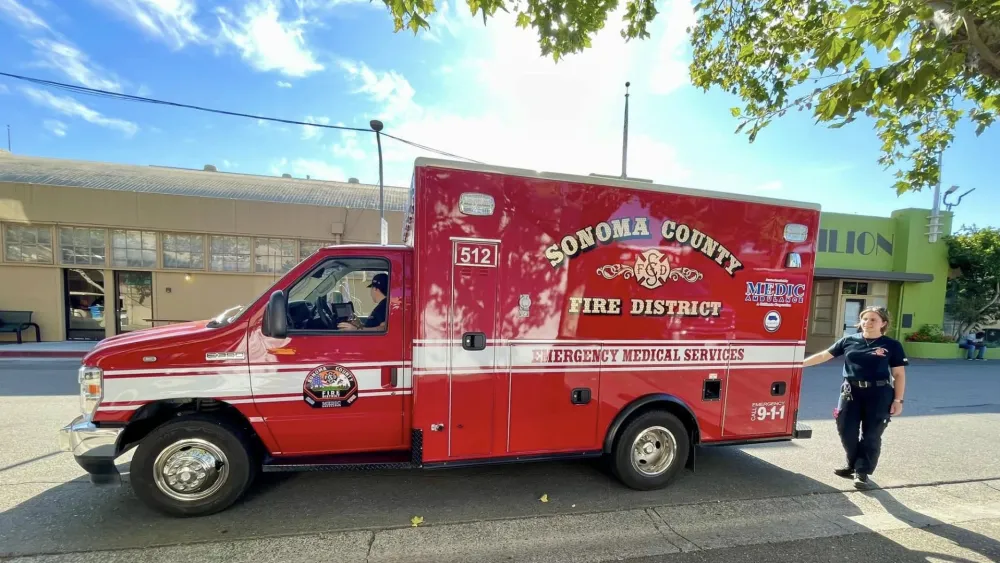
SONOMA COUNTY, CALIF. — The Sonoma County Fire District submitted a formal request July 2 for a 16.36% ambulance billing rate increase, marking the district’s second significant rate increase request since acquiring the county ambulance service contract from American Medical Response in January 2024.
Fire District Chief Ron Busch detailed the rate increase request in a July 2 letter addressed to County Health Services Director Nolan Sullivan. In a July 3 email transmitting that letter, Busch proposed a bifurcated approach: an immediate 9.9% increase, with the remaining increase and a cost-of-living adjustment scheduled for January 1, 2027.
The district projects ambulance program revenue of approximately $40.2 million for fiscal year 2026-27, contrasted against projected expenses of $42.7 million, creating a 6% revenue shortfall according to financial documents submitted with the rate increase request. The contract between the district and Sonoma County requires comprehensive audits when rate increase requests exceed 10 percent.
District officials cited multiple factors contributing to the financial pressure on ambulance operations. Primary among these are labor cost obligations resulting from salary and benefit increases American Medical Response granted ambulance personnel immediately before the district assumed the contract. The district was contractually obligated to match those compensation levels upon taking over service.
The district’s financial obligations also include a projected $2.4 million contribution to Redcom, the county’s emergency dispatch center, which was restructured in fall 2024. Under that restructuring, the fire district became responsible for one-third of dispatch center operational costs.
District reimbursement challenges are compounded by the composition of its patient base. Medicare, Medicaid, and uninsured or self-pay patients generate approximately $9.2 million, $11.3 million, and $1.2 million in annual revenue respectively, according to district financial documents. These categories operate under fixed or severely limited reimbursement rates established by federal and state programs and cannot be increased to address the district’s revenue shortfall.
Privately insured patients, comprising only 13.7 percent of the district’s ambulance calls, generate approximately $13.7 million annually and account for 39 percent of total billing revenue. The district stated it must direct rate increases toward this patient population to address the gap between revenue and expenses.
The district received a preliminary performance evaluation following its first year of operations. According to district communications, the county conducted a collaborative two-year audit measuring performance against contract compliance criteria, resulting in a first-year score of 91.6 percent, equivalent to an A grade. Negotiations continue between the county and district regarding ambulance response time standards specified in the contract.
This represents the district’s second significant rate increase request. In March 2025, approximately 15 months after assuming the contract, the district requested two increases totaling just under 25 percent, proposed for staged implementation beginning with a 9.9 percent increase. Those discussions appeared to stall, with county officials declining to characterize the outcome publicly.
In September 2025, the Board of Supervisors approved only a 2.4 percent cost-of-living increase, which the contract permits annually based on the region’s consumer price index.
Sullivan stated the county is currently evaluating the district’s rate increase request under established contract terms and will prepare a recommendation for the Board of Supervisors. Sullivan declined to specify when a recommendation would be presented, emphasizing the need to thoroughly evaluate the proposal and its impact on Sonoma County residents.