
By MES Dispatch Staff
The Briefing
- A Wisconsin appeals court on July 30 overturned a December 2024 lower court ruling that had declared Act 10 unconstitutional, reinstating the 2011 law that eliminated collective bargaining rights for most public employees including firefighters.
- The 2-1 appeals court decision reversed Circuit Judge Jacob Frost’s determination that the law violated equal protection guarantees by creating exemptions for public safety workers.
- The law has remained in effect throughout the legal proceedings and will continue under the appeals court decision; unions are expected to appeal to the Wisconsin Supreme Court, which is controlled by liberal justices.
- Act 10, championed by former Republican Governor Scott Walker in 2011, limited public employees to bargaining solely over wage increases not exceeding inflation and required employees to pay more for health insurance and retirement benefits.
- All five Democratic gubernatorial candidates have pledged to repeal Act 10 if elected; the Democratic primary election is scheduled for August 11.
MADISON, WIS. — A Wisconsin Court of Appeals reversed a lower court ruling July 30 that had invalidated Act 10, the 2011 anti-union law restricting collective bargaining for most public employees. The 2-1 appeals court decision upholds the law’s constitutionality.
Circuit Judge Jacob Frost had ruled in December 2024 that Act 10 violated the Wisconsin Constitution’s equal protection guarantees because it provided exemptions for public safety workers while restricting bargaining rights for other public employees. The appeals court rejected Frost’s analysis.
The three-judge appeals court panel determined the law had a rational basis for treating public safety workers differently and that Frost lacked legal basis to declare the statute unconstitutional. The court stated it must respect legislative precedent and defer to the Legislature’s fiscal policy decisions.
Act 10 took effect in 2011 after enactment by the Republican-controlled Legislature amid significant public opposition. The law effectively eliminated collective bargaining for most public workers by restricting negotiations to wage increases no greater than inflation. The law also eliminated automatic union dues deductions, required annual union recertification votes, and mandated increased employee contributions to health insurance and retirement benefits.
The lawsuit challenging Act 10 was filed by seven labor unions and three union leaders in November 2023, three months after Wisconsin’s Supreme Court shifted from majority conservative to majority liberal control following the 2022 state Supreme Court election.
Christina Brey, spokesperson for the unions, stated the plaintiffs remain confident on the merits and are considering all available options. Brey emphasized that collective bargaining rights enable employees to participate in decisions regarding class sizes, workplace safety, working hours, and other conditions.
Former Governor Scott Walker, who introduced and championed Act 10, characterized the appeals court decision as a major victory for state taxpayers and elected officials.
All five Democratic candidates for Wisconsin governor have committed to repealing Act 10 if elected. The Democratic gubernatorial primary election is scheduled for August 11.
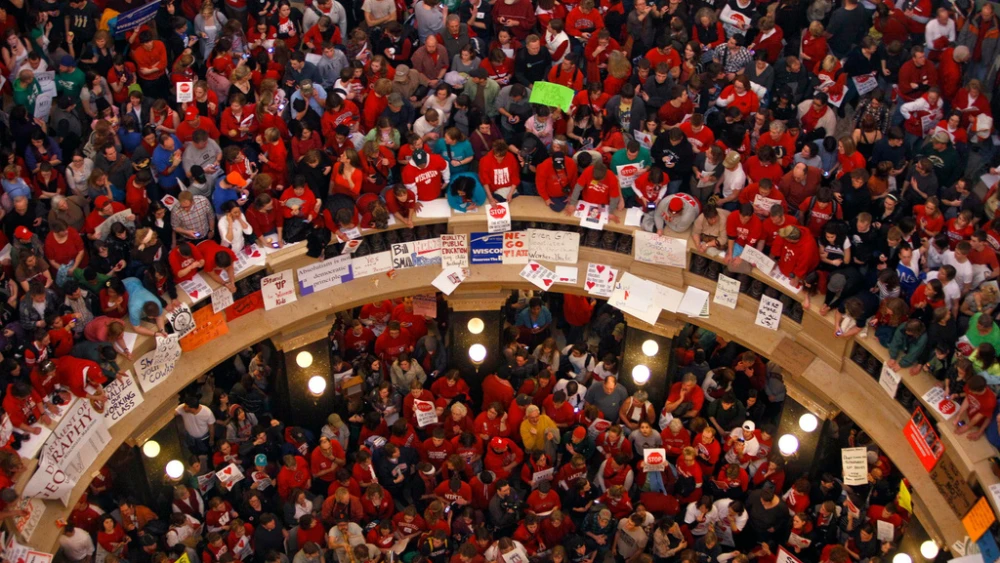
The act sparked weeks of protests in 2011, with demonstrations drawing as many as 100,000 participants to the state Capitol. Walker used the legislation to achieve national political prominence and later launched an unsuccessful presidential campaign.
Appeals Court Judge Shelley Grogan issued a concurring opinion criticizing the lawsuit timing as “suspect,” noting it was filed immediately after the Supreme Court’s composition changed. Grogan wrote that efforts to attack Act 10 on previously rejected grounds simply because court composition changed “must be rejected.”
Appeals Court Judge Lisa Neubauer, the sole liberal judge on the three-judge panel, dissented, stating Frost was correct and that the Legislature made arbitrary distinctions by restricting collective bargaining for some public employees while exempting public safety workers.
Unions are expected to appeal the decision to the Wisconsin Supreme Court, which currently has a 4-3 liberal majority.