
By MES Dispatch Staff
The Briefing
- A NIOSH report on the May 23, 2026, death of Boston firefighter Robert T. Kilduff Jr. found that fire damage and poor construction weakened a third-floor porch wall that gave way during overhaul.
- Kilduff, assigned to Rescue 2, fell about 20 feet to the asphalt after pushing and pulling on a smoldering wall section below a window at a three-alarm residential fire.
- The department’s cause-and-origin investigation found the fire started when lithium-ion batteries stored in a plastic toolbox went into thermal runaway.
- NIOSH found crews knew the rear of the building was compromised before overhaul continued there, that Kilduff had removed his SCBA, and that his helmet chin strap was not securely fastened.
- NIOSH recommended treating overhaul as a structural hazard, assigning a post-fire building survey, keeping full protective equipment on in hazard zones and strengthening ties with code enforcement.
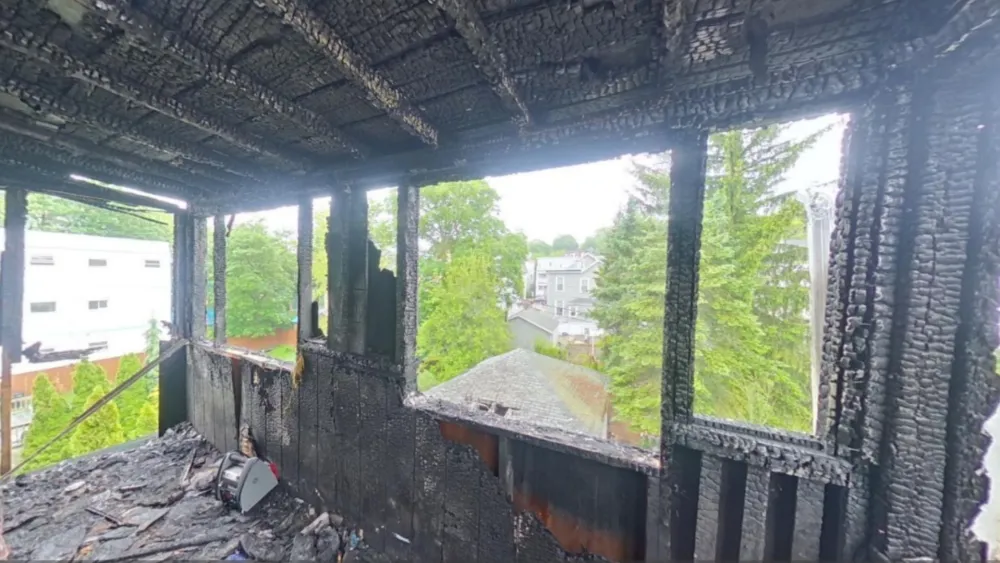
BOSTON — A National Institute for Occupational Safety and Health investigation into the May 23 death of a Boston firefighter found that fire damage and poor construction weakened a third-floor porch wall that failed during overhaul, FireRescue1 reported.
Fire department, NIOSH|Photo
Kilduff, a career firefighter assigned to Rescue 2, was working on an enclosed third-floor rear porch when he pushed and pulled on a smoldering wall section beneath a window. The section broke free, and he fell with it about 20 feet to the asphalt. A structural engineer who examined the porch found the failed section lacked king studs, jack studs, a header, a sill plate and cripple studs, and appeared to rely mainly on exterior sheathing for strength. The porch was originally open and later enclosed, and the roof above it was likely added later. Fire charred adjacent framing, and suppression and overhaul removed interior plywood, further weakening the wall. The engineer concluded that relatively minor lateral forces could cause it to fail.
NIOSH found that firefighters reported spongy porch flooring at 8:23 p.m., and overhaul began on the third-floor porch at 8:25 p.m. At 8:32 p.m., the Rescue 2 officer told command the rear stairway was severely compromised, and dispatch broadcast an urgent caution at 8:33 p.m., while several firefighters were on the porch and stairway. The report does not describe a formal post-fire building survey before overhaul began. Kilduff had also removed his SCBA while working, and his helmet chin strap was not securely fastened. The force of the fall dislodged the helmet before he hit the ground. The report does not say whether smoke exposure played a role.
City records showed a 1922 permit for a second stairway, but the porch enclosure involved far more work, including walls, windows and roof changes. A permit application to convert the house to a two-family dwelling was denied, yet the building operated as a multifamily occupancy. NIOSH noted that code enforcement was the responsibility of the city’s Inspectional Services Department, not the fire department.
NIOSH recommended four actions: treat overhaul as a structural hazard and keep reassessing a fire-damaged building’s condition; assign a qualified officer to survey the building before overhaul begins and consider alternatives such as hydraulic overhaul or shoring; keep SCBA and secured helmets on in any hazard zone, with supervising officers responsible for checking compliance; and have fire departments build working relationships with code enforcement so permit and renovation information reaches operations.