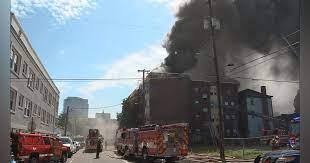
Firefighters are on the scene of a three-alarm blaze Tuesday morning inside a Southwest Portland apartment building at 1041 S.W. Taylor Street in Goose Hollow. The call appears to have come in around 10:30 a.m.
Heavy, black smoke is visible from downtown and throughout the Portland skyline.
Photos and video posted on social media by Portland Fire & Rescue show smoke billowing from the windows of the four-story structure as firefighters appeared to evacuate and rescue tenants and pets from the fire-escape stairs on the building’s facade.
By 11 a.m., fire bureau on-scene command directed crews to withdraw from the building because the fire was still growing. At 11:45 a.m., the agency tweeted that it had become a four-alarm fire and crews were performing a “Personal Accountability Report” — making sure all firefighters were accounted for.
Portland General Electric turned off power to the area, the fire bureau said. Outages are expected to last a few hours in the neighborhood.
It’s unclear if anyone is still trapped inside the building. Firefighters expanded the diameter around the building to protect neighboring structures because the apartment building may fully collapse, the fire bureau said. Emergency response vehicles were moved away from side of the building “in the event of a structural collapse,” the agency tweeted.
The apartment building is two blocks away from Lincoln High School, which lost electricity Tuesday morning.
Lincoln principal Peyton Chapman sent an email to parents just before noon, saying it appeared a transformer had blown nearby. The school is running emergency lights on emergency generators and bringing students who were off site back into the school due to the worsening air quality from the “massive fire.”
Durham firefighters feel they’re underpaid and their wages are making it hard to retain staff.
The department that ran more than 31,000 calls for service in 2022 has a problem with retention, WRAL reported.
Since January, 17 firefighters have left. And, about 60 percent of those remaining have less than five years of service.
The roots of the issue lie with the COVID-19 pandemic. The union said the city froze salaries citywide more than three years ago.
The way a firefighter’s pay is structured, they receive a 5% merit raise every year. With the exception of that mid-year adjustment 16 months ago, They haven’t seen a merit increase in more than three years.
“Not one Durham firefighter I’ve talked to, not one is asking for a raise right now,” said Jason Davis, president of Professional Firefighters of Durham. “What we’re asking for is for them to keep their end of the deal. We all signed up. We knew what the starting pay was going to be and when they laid that paper in front of us and said as long as you do a good job you’re going to get your 5% [raise] every year. They haven’t kept the end of the bargain yet. That’s what we just want them to do, keep their end of the deal.”
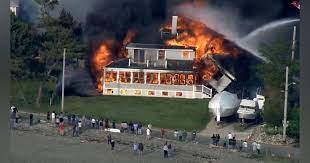
Firefighters on the South Shore of Massachusetts are being praised for their efforts at a massive house fire Monday evening.
Hull Fire Chief Chris Russo told a WCVB reporter the combination of intense flames and strong winds caused siding to melt on the house across the street.
“There was a lot for them to contend with, but they did a tremendous job of keeping this to one house and not losing a whole block.”
Sadly, a dog perished in the fire. No other injuries were reported.
Departments from seven nearby towns responded to assist with the fire.
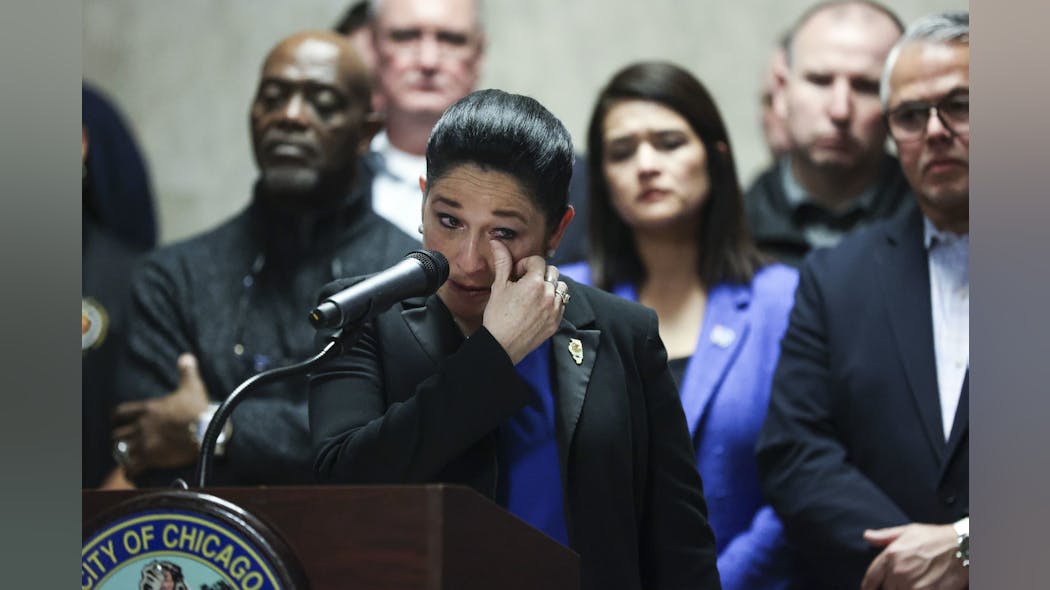
IL Comptroller Susana Mendoza wipes a tear while speaking on behalf of her brother, police Sgt. Joaquin Mendoza, during a news conference at Chicago’s City Hall on Feb. 21, 2023.
A day before the state and federal governments’ COVID-19 mitigation protocols are set to expire, Gov. J.B. Pritzker on Wednesday signed into law a measure aimed at making it easier for Chicago’s first responders to acquire full benefits if they suffered long-term disability because of the virus.
The legislation was pushed by Illinois Comptroller Susana Mendoza, whose brother, Chicago police Sgt. Joaquin Mendoza, was infected with COVID-19 and fell badly ill, but was denied full disability benefits by the Policemen’s Annuity & Benefit Fund of Chicago.
“I am super sad that it happened to my brother. … I absolutely am horrified by it and mortified by it,” Mendoza said during a signing ceremony at the Illinois State Capitol. “And in a terrible twist of fate, he and I are both thankful that it did happen to him because I wouldn’t have even known about it otherwise.”
Under the measure, it would automatically be assumed that Chicago police officers, firefighters and paramedics who suffered long-term disability from COVID-19 contracted the virus because of their working conditions.
The law will apply to Chicago police officers, firefighters and paramedics who got sick with the virus from March 9, 2020, through June 30, 2021. If they were previously denied a duty disability benefit they could acquire “a retroactive duty disability benefit.”
“For these first responders, serving and protecting wasn’t just their job, it’s been their calling,” Pritzker said. “There are no words to describe the anguish and pain, both physical and emotional, that they’ve been through. But when our first responders aren’t given their full due, the state of Illinois won’t let them down.”
Legislation passed during the height of the pandemic stipulated that first responders statewide would be entitled to various protections if they contracted COVID-19, and considered it would be automatically assumed that they caught the virus while on the job. But that law didn’t apply to Chicago police and firefighters because they’re on a separate disability system, state officials said.
The measure signed by Pritzker on Wednesday was passed unanimously by the House and Senate. It takes effect immediately.
“We do do things sometimes in a partisan fashion here, and we do it for the right reason. And this is one of those times,”state Rep. Jay Hoffman of Swansea, a top ranking House Democrat and one of the bill’s chief sponsors, said at Wednesday’s news conference.
The comptroller accused the city of Chicago of setting impossible standards for cops like her brother to receive full benefits and criticized Mayor Lori Lightfoot’s political appointees on the pension board for their decision. Lightfoot has denied that she had any influence over the board’s decision.
Mendoza has said her brother contracted COVID-19 in 2020 — before the availability of the vaccine — while working 17 straight days on the job. He spent 72 days in the hospital, suffered kidney failure, lost the ability to use his left arm and suffered a number of strokes.
Duty disability provides 75% of the officer’s salary and free health insurance. On ordinary disability, an officer receives 50% compensation and must pay for health care.
Mendoza has said her brother is on ordinary disability, which she’s said, “essentially acknowledges that he’s disabled but says that because he could not prove which specific act of duty as a police officer led him to contracting COVID,” he wasn’t entitled to the full duty disability benefits.
Susana Mendoza and Lightfoot held dueling news conferences about the issue the week before Lightfoot lost her bid for reelection on Feb. 28. While Mendoza accused Lightfoot of being neglectful of officers like her brother, the mayor defended the pension board’s 4-3 decision to deny him the benefits in 2022.
The decision, which included four “no” votes from Lightfoot appointees, was also upheld in court after Joaquin Mendoza challenged it.
Susana Mendoza, who ran unsuccessfully for mayor in 2019 against Lightfoot, has insisted that the timing of her decision to go public with her brother’s story had nothing to do with the mayoral election.
“This was an injustice that was done and frankly it should not have taken legislation to fix this,” Mendoza said at the news conference.
A Turtle Creek volunteer firefighter will be wearing a different helmet later this week — that of the Los Angeles Rams.
Mike McAllister, an undrafted free agent with the Rams, is headed to rookie camp in California on May 12, WTAE reported.
“Since I was 9 years old, I told people I was going to play in the NFL,” McAllister said, adding that he got the call he dreamed about at 8 p.m. last Saturday. “These months of hard work finally paid off, and I’m under contract to play in the NFL.”
He joined the fire department as a teen. “I fell in love with it at a young age, and I’ve always made time for this place. It’s like a second home to me, I just like the idea of volunteering the free time that I had.”
His free time was limited though because of another passion — football. But you’d find him hanging out at the firehouse during the summer and on other school breaks. As he joined others responding to emergencies, he did his best to avoid injury.
Fire Chief Jack Osman has been cheering McAllister on since his time as a Woodland Hills High School Wolverine, then as a center offensive lineman for Youngstown State University.
“You’re trying to guess who he might go to, and it was like, OK, anything but Cleveland. Cleveland, we don’t want to hear,” Osman said.
“To hold him back, it’s kind of hard to get in front of him to stop him. And you know that’s why he’s going to the NFL. He still has to make the team, but he’s a hard worker. He doesn’t do anything halfway.”
McAllister said his fellow firefighters couldn’t be happier for him.
“It’s a big family down here, and one of their family members just saw his life’s dream come true.”
May 10—Addressing a rise in harassment and violence against Seattle Fire Department personnel, the City Council unanimously voted on Tuesday to make it illegal to obstruct a firefighter’s response to an emergency.
Under Seattle’s municipal code, a range of public officials, from fire marshals to code inspectors, are protected from obstruction. But the code currently does not apply to SFD personnel.
In a 6-0 vote, the council made obstructing a firefighter’s duties — or refusing to leave the scene of a fire department emergency response — a gross misdemeanor, with a penalty of up to $5,000 and 364 days in jail, following pleas from firefighters.
District 1 Councilmember Lisa Herbold, who co-sponsored the bill and chairs the Public Safety and Human Services Committee, described the addition of firefighters to that list of public officers as a “technical change” in an April committee discussion.
“I thought it was stunning that the ordinance does not include firefighters in its current state,” District 7 Councilmember Andrew Lewis, who co-sponsored the bill with Herbold, said after Tuesday’s vote, adding that the new policy “closes an important loophole.”
Lewis said he and Herbold worked with SFD Chief Harold Scoggins and IAFF Local 27, the union representing firefighters, to draft this policy in an effort to stop an apparent rise in obstruction on calls, particularly those in encampments or other sensitive public spaces.
A slew of fire department staff members testified to the council ahead of Tuesday’s meeting, as well as the committee discussion, saying that the obstruction protection was necessary to protect both first responders and patients receiving care.
Concerns ranged from protecting a patient’s medical privacy when they respond to an incident in a public space to protecting the physical well-being of responders and patients, who have been repeatedly threatened and assaulted on calls.
“Violence and the threat of violence at incident scenes — which are our workplace — has increased significantly over the last few years,” Kenny Stuart, an SFD lieutenant and president of Local 27, said Tuesday.
According to Stuart, SFD and the union have created a tracker to monitor these incidents and it shows more than 50 incidences of violence over the last six months. Other firefighters shared stories of being threatened with pipes and broken mops, pelted with rocks and shoved — or otherwise physically obstructed — from administering care or responding to a fire.
“When seconds and minutes count, these violent and distracting actions delay our response and hinder care,” Stuart said, supporting the amended ordinance.
Some community members, however, raised concerns about the overinvolvement of police in otherwise noncriminal calls, and warned that the law could be used as a crowd-control measure during protests, with a disproportionate impact of enforcement on disenfranchised communities, as they described.
LéTania Severe, who lives in Seattle but is a firefighter in Pierce County, said the city should reject the proposal because of its potential equity issues.
“This bill will not only fail to protect firefighters, it will make things worse for them and the communities they serve, particularly the Black community members who face disproportionate arrests and prosecutions under the existing obstruction statute,” Severe said.
Severe said that the city would likely worsen systemic issues and inequities if they implemented the change without doing an immediate study into the impacts of the proposal.
“If your goal is to improve the work environment for firefighters, there are many things that you can do such as training, more staffing, better schedules, [and] addressing systemic failures — such as our housing failure, our mental health failure, our drug situation,” Severe said.
A memo from council central staff highlighted the risk of racial injustice in the application of this new law, noting that from 2019-23, obstruction arrests were disproportionately made against people of color, with Black people representing about 34% of the arrests, despite making up just under 7% of Seattle’s population.
But council members contend that the bill is designed to prevent situations from escalating into other arrestable offenses, which are unsafe and can carry more serious charges.
“This policy could be implemented without ever needing to make an arrest,” Lewis said, explaining that SFD having the authority to make someone leave if they are obstructing could be enough in many cases without any actual enforcement.
“We’re giving firefighters the legal right to de-escalate. The police are already there, they just can’t do anything right now until a firefighter gets assaulted,” he added.
Councilmember Teresa Mosqueda, who was absent from Tuesday’s meeting and did not vote on the legislation, introduced three amendments that addressed concerns around increased police involvement — all of which were adopted.
The amendments prevent someone from being charged in the obstruction of their own care, require SFD and the Seattle Police Department to conduct a study of the racial equity of this new legislation by the end of August, and request the departments create a policy addressing when SPD would engage with an SFD call, suggesting that it be limited to when SFD requests police presence.
May 10, 2023 A 94-year-old woman and her son died in a blaze over the weekend sparked by the batteries.
By Ellen Moynihan, Kerry Burke and Janon Fisher Source New York Daily News (TNS) Distributed byTribune Content Agency, LLC.
A 94-year-old Washington Heights matriarch and her son died Monday from injuries suffered in a fast-moving e-bike fire in the family’s Manhattan apartment over the weekend, fire officials said Tuesday.
The deaths of Bertha Domenech Santiago and her son, Luis, mark the sixth and seventh fatalities caused by the ignition of lithium-ion batteries — used for electric bikes, scooters and hoverboards — surpassing the number of fire deaths from 2022, according to the FDNY.
A home health aide who attended to the elderly woman and an unidentified male tenant were also injured after the batteries caught fire in Santiago’s fourth-floor apartment on W. 190th St. just before 1 p.m. Sunday, neighbors and officials said.
A dozen units and 75 firefighters brought the fire under control about an hour later, officials said.
“Firefighters responded to the scene of a heavily involved fire in Washington Heights. Four people were removed from that fire and critically injured. It was fast-moving and extremely disruptive,” FDNY Commissioner Laura Kavanagh said.
“Unfortunately and tragically, two of those people have since died and two others remain in extremely critical condition and we’re continuing to pray for their recoveries today.”
Luis Rosario, 31, an electrician who grew up on the block with Santiago and her son, described her as a neighborhood fixture.
“I’ve known her ever since I was born,” he said. “She was the neighborhood grandma. She was extremely loving.”
He said that in more recent years, as she advanced in age, she was less visible in the neighborhood. She wore braces on her legs and hands, he said, to cope with a health condition.
“She used to be out here with her little dog, Nikita,” Rosario said. “She used to give us two bucks to walk her little chihuahua. That was our first hustle. She babysitted all of us. She was famous all over the block.”
Rosario, who lives in the building where the fire happened, said that the midday fire shattered the quiet Sunday in Washington Heights.
“There was an explosion and you felt everything shook,” Rosario said. “It happened so fast.”
Another neighbor, Sev Maldonado, said that he saw EMS workers trying to resuscitate the four victims.
“The firefighters brought all the four people out on stretchers,” said Maldonado, a restaurant worker who lives on the floor below the fire. “EMTs were performing CPR on all of them. None of them were responding. It was scary. I never saw anything like it.”
Early Tuesday, a suspicious fire killed a Brooklyn mom and her 18-year-old daughter in their apartment building and her three younger children were critically injured. Police declared the deaths to be homicides.
Later that morning, a 70-year-old woman was killed in a Bronx apartment building blaze.
An Alaska cruise, hotels, gifts, a trip to a clothing-optional Jamaican resort, diamond rings, and tickets to basketball games are among things North Amityville fire officials enjoyed on taxpayers’ dime.
An investigator with the New York comptroller’s office unveiled lavish personal spending with no oversight, according to CBS New York.
“We had been given this information by people in the department who were very upset by the fact that they were there to save lives. They weren’t there to allow this kind of thing to go on,” Babylon Town Supervisor Richard Schaffer told a reporter.
A former chief and six of his board members allegedly spent more than $500,000.
A criminal probe is ongoing.
When the lavish spending spree came to light, the firehouse was shut down for two months to clean house.
“We enacted procedures that create significant accountability, financial accountability and codes of ethics, so these types of things will never happen again,” said Brad Pinsky, the attorney for the North Amityville Fire Department.
“Number one goal right now is to just make sure that everyone’s safe in the community, make sure that we serve the community properly. No more expenditures for extravagant trips or anything like that,” said Rashada Delany, North Amityville’s new volunteer fire commissioner.
May 9—SABATTUS — Fire Chief Troy Cailler resigned Tuesday from the position he has held since the spring of 2020.
Cailler, who was able to hire the department’s first full-time firefighters in the fall, said his resignation was prompted by a disagreement over current town politics, including a plan to halt growth at the department.
“Due to the recent issues with the town and the drastic change in direction (in which) the town manager and select board would like to see this organization go,” Cailler wrote in his resignation letter posted on Facebook, “I can no longer support the changes they want to see. I took the job to be the best we could be and do the right thing always. I do not want to compromise my morals to save my job. So, with that, I thank you for a hell of a ride and for the support, however it is time for me to move on.”
In his three years as chief, Cailler made ample use of federal and state grants to hire firefighters and to get the department up to snuff with the latest equipment. He also managed to secure $2 million in federal funding to build a new central station and upgraded the department’s badly outdated equipment.
“We have one of the best water rescue boats in the state, maybe even New England,” Cailler wrote, in a personal thanks to the residents of Sabattus. “We were able to have a UTV (utility task vehicle) donated to us. We have added a new engine, command vehicle and EMS fly car to our apparatus fleet. We have been so fortunate with all the new equipment we have been able to obtain through the various grants.
“I could not be more proud of where this organization stands currently,” Cailler wrote. “We have made so many great improvements over the last three years. We have grown exponentially and now have a waiting list of applicants. Our daytime staffing has grown and proven its worth daily … We all learned a lot and taught a lot in the hours of trainings we held. But the biggest thing we all did, we all became family, we loved each other and looked after each other.”
Cailler had become popular among the citizens of Sabattus, who in reaction to the news of his resignation largely blamed town leadership for his departure.
“This is so unfortunate,” one Sabattus woman wrote on Facebook in reaction to Cailler’s post. “I applaud you for your hard work, all of the improvements you made and writing a classy resignation. I am sure there is much more to be said. The town manager should be bending over backwards to have you stay. Such a shame.”
“Why does this town continue to lose quality leaders every few years?” one local man demanded to know. “I have an idea what it might be. We need change.”
“You did a great job,” offered another in reaction to Cailler’s post. “Unfortunately, you’re not a politician.”
Others, though, remarked on social media that the town had to slow the progress of the fire department to keep taxes from spiraling out of control.
“The reality is, we do not have a lot of businesses in Sabattus, like some of the surrounding communities to soften the tax blow,” wrote man, who has lived in the town for 23 years, “so the property tax burden falls on individual home owners.”
Yet some maintain that losing Cailler may cause a snowball effect within the fire department.
A current Sabattus firefighter, who didn’t want to be named for fear of retaliation, said that Cailler’s leadership was so effective that it drew quality firefighters to the department while other departments struggle to maintain their rosters. Impressed by the opportunities presented by Cailler’s management of the department, the firefighter said, firefighters were leaving bigger departments to work in Sabattus.
He also said Cailler’s popularity might have been his undoing, suggesting that the chief was pressured to resign by town heads who were threatened by his success.
“I think that they put their egos and personal agendas ahead of what’s best for the community,” the firefighter said. “I think it’s a catastrophic mistake that puts the safety of the citizens of Sabattus at risk.”
Like others, the firefighter suspects that the department will start losing staff now that Cailler is gone.
“My guess is that they’re going to lose a lot of people,” he said.
Town Manager Timothy Kane said Deputy Fire Chief Rob Gayton has agreed to serve as fire chief on an interim basis until a permanent replacement has been selected.
“We have the utmost confidence in the ability of the Sabattus Fire Department to effectively fulfill its public safety mission during this transition,” Kane said.
Cailler started his career as a firefighter in 2008, when he was hired by the Litchfield Fire Department as a junior firefighter at the age of 16. From there, he went to Southern Maine Community College and was a live-in student in Scarborough.
In 2013, during his last year at SMCC, he was hired by the city of Lewiston as a full-time firefighter the same week arson fires destroyed nine downtown buildings. At the same time, Cailler, a native of Litchfield, volunteered with the Litchfield and Scarborough fire departments and has continued to do so over the past seven years.
Once he was hired as the Sabattus chief — at the age of 27 — Cailler hit the ground running, working through the travails of a pandemic to get town business done. Among them was the purchase of a new firetruck to replace the aging 1991 E-One Ford they had been using, and a new command vehicle.
After taking over as chief, Cailler also got busy applying for grants and before the year was done, four of them had come through — Stephen King’s foundation provided $10,000 for rope and ice-water rescue, and the department got another boost from an FM Global grant that allowed them to buy a drone, expected to be used during water rescues, wildfires and similar emergencies. Through the grants, Cailler also brought in money to pay for a harness system, bailout kit and gas meters, among other things.
The Sabattus annual Town Meeting is slated for May 24 and will include a proposed $368,000 budget for the Fire Department and EMS services combined. Cailler on Tuesday said he had no problem with the budget — it was internal pressures that prompted him to resign, he said.
Cailler continues to fight fires with the Lewiston Fire Department. He said he intends to focus on that work and to spend more time with his family before deciding his next professional move.
The fire at Hawthorne Country Club, was once a popular wedding venue in the Dartmouth area, is being investigated as a possible arson.
The state fire marshal’s office is investigating the fire at the vacant club, according to WJAR.
“…There’s no reason for it to go off. There’s no electrical running. There’s no gas running. Nobody’s in the building, so it is where you lead to at first,” Dartmouth Fire Chief Erick Turcotte said.
The property has sat vacant for about eight years. However, the Toll Brothers decided last week to buy it.
Since the agreement hadn’t gone through, they don’t own it, a spokesperson said of the $3 million property.