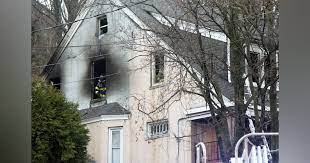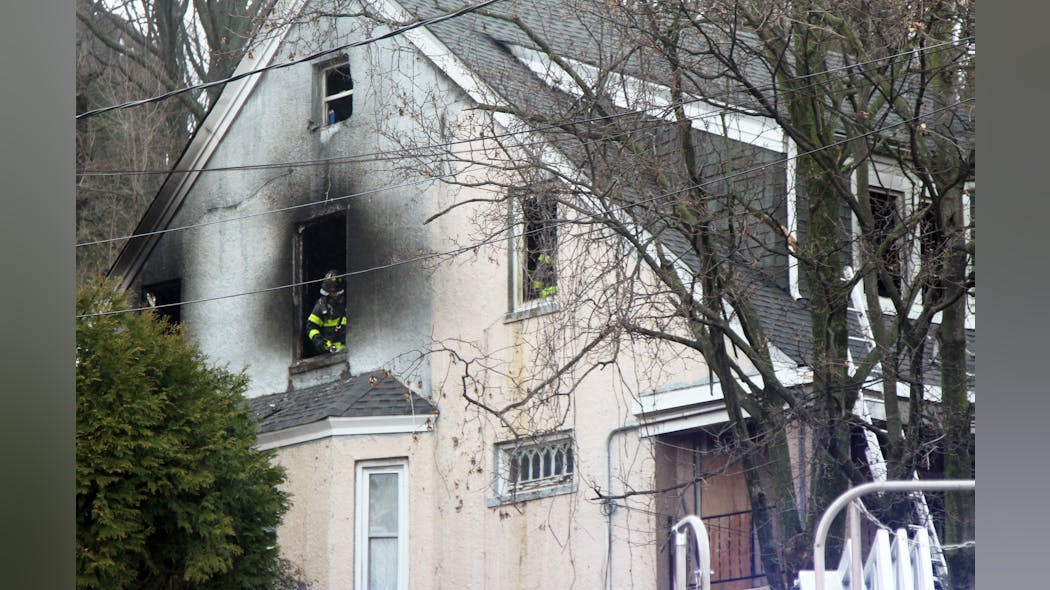
Six Pompton Lakes firefighters who were in a house when it exploded walked away with minor injuries.
Dramatic body cam footage of the January blast has just been released, CBS2 reported.
Just seconds before, footage shows one firefighter walking into the home from the porch.
“Two of them were blown out because they were right by the door. They got blown out the door into the driveway,” Pompton Lakes fire official John Keating told reporters.
Two firefighters, along with a lieutenant, were in the basement and the lieutenant helped them out.
Three other firefighters including an assistant chief, were on the first floor. Two were pulling a line into the home.
“It was the assistant chief and the two other guys who got blown out. Thankfully, they were in the right spot of the house,” Keating said, adding that their gear saved them.
“They have their full-time jobs. They have their families, and they give up their time to come to something like this. It’s really truly amazing,” a neighbor, Tracey Alvarez said.
She went on to describe the incident: “The house literally lifted off the foundation and came back down. It was like The Wizard of Oz.”
All those injured are volunteers.
The assistant fire chief had burns to his ears because his hood blew off while the lieutenant, suffered third-degree burns to his hands.
Feb. 27, 2023 All eight of Lincoln Fire and Rescue’s medic units will be equipped with the latest emergency medical response and cardiac care technology.
Feb. 17—All eight of Lincoln Fire and Rescue’s medic units will be equipped with the latest emergency medical response and cardiac care technology thanks to a $2.2 million investment from the city, officials announced Friday.
The new equipment includes 35 cardiac monitors that will alert first responders earlier to changes in a patient’s heart condition and a dozen “power cots” that could lift 750-pound patients without human assistance, said Jamie Pospisil, the department’s chief of emergency medical services.
Altogether, the new equipment — which also includes 20 heart rhythm simulators, six automatic external defibrillators and 12 “stair chairs” that help responders move patients up and down stairs — is meant to reduce the strain on firefighters and paramedics while helping improve patient outcomes, Fire Chief Dave Engler said.
“The new equipment will also make certain that the members of our community are getting the best patient care,” Engler said at a Friday news conference at Lincoln Fire and Rescue Station No. 15, where he appeared alongside Pospisil, Medical Director Noah Bernhardson and Mayor Leirion Gaylor Baird.
Also added are eight automated compression delivery devices, which replace the need for first responders to hand-deliver chest compressions when performing CPR.
The department’s seven regularly used medic units — along with an eighth medic unit Engler activated earlier this month to serve during peak call hours to ease paramedic workload — will be outfitted with the equipment, which officials repeatedly said would be “lifesaving.”
Lincoln Fire and Rescue reserve medic units, which are deployed when all normal medic units are out on calls, will also be equipped with the department’s latest purchases, which Engler said were included in the agency’s annual budget.
And each of the department’s engine companies will also be equipped with a state-of-the-art cardiac monitor, Pospisil said.
The city is leasing the equipment from Stryker Sales, a medical equipment manufacturing company, for $2.19 million over the course of 49 months, paid in annual installments of $439,000, according to the city’s lease agreement with the company.
Pospisil said the city will have to replace the equipment when the lease period ends.
The equipment is meant to provide an additional boost to the city’s response to cardiac arrest calls — an area where Lincoln Fire and Rescue already excels, with a cardiac arrest survival rate that is more than double the national average.
Bernhardson, the department’s medical director, credited that success both to the agency’s medics and Lincoln’s residents, who, as bystanders, provided CPR in 70.8% of the 141 non-traumatic cardiac events in 2022, he said.
The national average for bystander intervention is 40.8%, he said.
“This is an outstanding contribution by the members of the Lincoln community,” Bernhardson said, before encouraging all residents to learn to administer CPR.
For Gaylor Baird, Friday’s announcement marked the latest in a series of news conferences where the mayor has touted her office’s investment in the city’s public safety agencies — a theme that has become a hallmark of her reelection campaign.
“As Lincoln grows, my administration continues to prioritize public safety investments in our city budget that keep you, your families and our first responders safe,” she said. “Those investments are contributing to impressive results.”
Earlier this month, the mayor announced that the Lincoln Police Department’s Special Victims Unit had moved into the BraveBe Child Advocacy Center following a public-private expansion of the center, which was predominantly funded by a private fundraising campaign.
And last week, Gaylor Baird unveiled a $400,000 federal grant the city received from the U.S. Department of Transportation to help create a traffic safety action plan in an effort to eliminate traffic fatalities in Lincoln.
Reach the writer at 402-473-7223 or awegley@journalstar.com.
Firefighters, EMS crews and officers examine the scene.
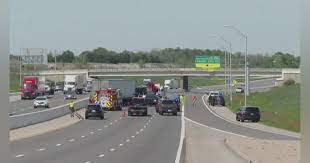
Western Taney County firefighters likely recognized the vehicle involved in a crash Sunday afternoon.
It was the General Lee from the Dukes of Hazzard.
The two occupants were transported to a hospital for minor injuries.
The vehicle was the historic car used on the set of the popular show. They noted that there were 309 General Lees built for the show and another 26 made for the 2005 remake.
Roy City Fire and Rescue has replaced its aging ambulances with new larger rigs.
They are larger and more powerful, crews told KSL.
“Even though we are a fire department, most of what we do is medically related,” Battalion Chief Jake Rast said, adding that 90 percent of the 6,078 calls last year were EMS-related.
“I think we average right around 21 calls a day, at times last year,” Rast said.
“Plenty of power: It gets us where we need to go,” said Battalion Chief Jake Rast.
Morgan Palmer, an advanced EMT, said she has noticed a big difference in the new ambulances.
“It’s bigger — more spacious — lets us get ready quicker for those fire calls,” Palmer said…”There are people pulling to the left. There are people stopping. There are people going to the right, so you have to be basically NASCAR!”
The new colored light options are another telltale sign the ambulances are new. In this case, the blue lights are known to be more calming for patients and everyone on hand.
All the providers said they’re really happy about the increase in space.
“The size of the compartments gives firefighters going on calls more space to work and better patient care,” Rast said. “You can hang fluids from both of these, so if people need medications via IV lines…Those are newer. It stabilizes the bag, too.”
A Philadelphia firefighter suffered serious injuries in a fall from a roof while battling a fire Saturday.
Firefighter Randy Ballinger fell about 25 feet from the roof at the two-story house in Kingseesing, WPVI reported.
Ballinger, assigned to Ladder 13, suffered a collapsed lung, broken ribs, a broken pelvis, and multiple long bone fractures in both legs.
By Monday morning, the GoFundMe has raised over $44,000, reaching closer to its goal of $50,000.
“On this job things happen. For all the safety precautions we have, this is something that just happened. I believe Randy was lowering his equipment off the roof through a rope, lowering saws down and was in the overhaul process where he got hurt,” Raymond Vozzelli, a trustee with Local 22, IAFF Philadelphia Firefighters’ & Paramedics’ Union, told reporters.
“Just keep the firefighters in mind. It’s a dangerous job. The more positive vibes we have coming to us the better.”
Evidence shows the Care Flight plane that crashed Friday night killing everyone aboard broke up in flight.
NTSB officials will be on the scene near Stagecoach, NV for days.
“How do we know if the airplane broke up in flight? We found parts of the airplane one-half to three-quarters of a mile away” from the crash scene, NTSB Vice Chair Bruce Landsberg told reporters at a briefing. “Right now, we just don’t know. This is like a three-dimensional puzzle. It’s harder when you don’t have the pieces all in one place.”
The pilot of the single-engine Pilatus PC-12 was notified about turbulence in the area around Reno. Audio recordings revealed the air traffic controller issuing the warning and moments later, trying to reach him again.
Airline pilots also tried to communicate with the plane and were asked to keep an eye out for wreckage.
It took local firefighters more than two hours to find the downed aircraft.
Scott Walton was a PC-12 pilot and spent many years flying and teaching students around the world. He left behind a wife and three small children.
The others aboard the Flight Care plane included Flight Medic Ryan Wilson, a new father; Flight Nurse Ed Prikola, a father with two young children; Mark Rand, the patient, and his wife, Terry.
Fire and rescue personnel along with law enforcement officers from the Stagecoach and Reno areas escorted the crew.
Feb. 27, 2023 San Antonio firefighters had to use poles and other tools to get to the patients.
By Taylor Pettaway, Jacob Beltran Source San Antonio Express-News (TNS) Distributed byTribune Content Agency, LLC.
Feb. 24—An elderly man is dead and his wife is in critical condition after the couple was mauled by dogs in a West Side neighborhood Friday afternoon.
San Antonio police said Friday evening that they had arrested Christian Alexander Moreno, 31.
Moreno is facing charges of attack by dangerous dog, causing death, and injury to an elderly person, the San Antonio Police Department said in a Facebook post. Both are felony charges. No further information about Moreno was provided.
First responders were called to the 2800 block of Depla just before 2 p.m. for reports of a dog attack. When firefighters arrived on the scene, they could see an 81-year-old man being dragged by a dog, and firefighters could see the man was “completely bloody before they even got out of the truck,” Fire Chief Charles Hood said.
The firefighters had to repel the dogs with pickaxes and poles in order to get to the man.
His wife, 74, also was mauled, officials said.
In addition to the couple, a relative of the couple was bitten, according to a city news release. A fire department captain also was bitten in the leg during the altercation, officials said.
All four people were taken to the hospital, where the 81-year-old died, the city news release said. The other three are still under medical care, it added.
“No one expects to go out and fight dogs in the way they did today,” Hood said. “It was a horrific scene, horrific for the people who had to experience it and for the firefighters who were part of the rescue who had to save themselves and these people attacked today.”
Officers with Animal Care Services learned that three Staffordshire terriers, a type of pit bull, who lived at a nearby property had become untethered and left the yard they were kept in. Witnesses said the dogs had broken through the front gate, according to the city news release.
At least two of the dogs attacked the couple as they got out of their vehicle, according to the release. The two were visiting a resident in the house next to dogs’ home, the police said.
Video taken by an unidentified resident shows one dog attacking the man while other dogs stand nearby in an aggressive posture.
ACS took custody of all three dogs. They will be euthanized, according to the city news release. Multiple charges are pending, it added.
This is not the first time ACS has been called to that property for reports of a dog bite.
At least two of the dogs were involved in “confirmed bite cases” in January and also in September 2021, according to the city news release. The injuries in those cases were described as “moderate or mild,” and the individuals involved “declined to file a dangerous dog designation,” the release said. The animals were returned to their owner after a quarantine period in accordance with state law.
A dangerous dog designation would have imposed several requirements, including that the owners keep the animals in a secured enclosure, get a $100,000 liability insurance policy and muzzle the dogs when they were outside. Special warning signs also would have been required.
In addition to the bite cases, ACS has been called to the property several times in the last two years for calls about neglect, aggression and loose animals, ACS Director Shannon Sims said.
Silvia Hernandez, whose family lives across the street from the pit bulls’ owners, said the residence has a history of aggression. She said her brother was bit by the dogs in 2021 and that the owners did not face any consequences.
“The owners don’t care. The problem are the owners who use these dogs as a form of protection and they make these dogs more aggressive. Dogs will be however you train them to be,” Hernandez said. “There is not enough accountability on the owners.”
Hernandez was at the scene after her mother, who lives with her brother, called in a frantic state during the attack. Worried that her mother was the one being attacked, Hernandez rushed to the Depla residence and was met by a chaotic and bloody scene.
“It shouldn’t have gotten to this point,” she said.
The teenagers were initially charged with arson, but the felony murder charge was added by the Office of the Maine Attorney General in October 2021 because Betu’s death happened during the alleged act of arson, which is a felony crime.
Two of the three juvenile’s names have not been made public. The Sun Journal has not published any of their names.
Active-retired District Court Judge Keith Powers ruled last year that none of the three juveniles was competent to continue with the criminal judicial process and future court hearings were suspended.
His ruling came after the defendants had been examined by a state forensic psychologist.
The teens are expected to be examined again periodically to determine whether they have become competent to proceed in court, according to Powers. No court documents indicated any of the charges against the three had been dismissed.
The teenagers were taken into custody after the fire and placed at Long Creek Youth Development Center in South Portland.
No information about their current detention was found in court files.
The fire heavily damaged the third and fourth floors in the 10-unit apartment building and left 27 tenants without housing, according to authorities.
Feb. 25—A dock fire at Markley Cove on Lake Berryessa destroyed one-third of the dock and more than two dozen watercrafts that included house boats, pontoons, long boats and jet skis on Friday night.
No injuries to civilians or firefighters were reported.
The fire was reported just before 9 p.m. on Friday. Cal Fire and other local agencies were called to the scene and firefighters were able to stop forward progress on the scene, which naturally caused parts of the dock to sink. The incident was officially terminated just after midnight, according to Cal Fire spokesperson Jason Clay.
On Saturday morning, Markley Cove officials conducted an inventory count and found estimated 23 watercrafts have been destroyed. According to Clay, that number is expected to fluctuate as the investigation continues.
As of Saturday morning, the cause of the fire was still under investigation by Cal Fire. Clay said much of the destroyed property sank, and the agency is awaiting a full assessment of damaged and destroyed property.
Other agencies on the scene included Napa County Fire, St. Helena Fire, Winters Fire, Napa County Sheriff’s office, AMR, and CHP deployed at least one helicopter.
World Trade Center Local 3 electricians (from left): John Ditre, Mike Catuogno, Gregory Rodman, Lou Schneider, Barry Himmelfarb and Tony Recco
When someone mentions the attack on New York’s World Trade Center (WTC), thoughts immediately turn to Sept. 11, 2001. The 9/11 terrorist attack killed a reported 2,753 people at the site, including 343 members of the FDNY. It was among the most tragic days in American history. It was a day to “Never Forget!”
But, when discussing the attack on the WTC, there is a large group of people who have another date that they will never forget—Feb. 26, 1993. It was on this day that the first attempt to bring down the towers occurred.
Among those who will never forget that day 30 years ago this weekend is a small group of WTC electricians who were working that day. Gregory Rodman and John Daddario were among that group.
Rodman, now the shop steward at Rockefeller Center/NBC remembers it starting out as a typical day.
“I was on the B-4 level, which is four grades below level, with Kevin Flannery and we went back to the workshop because my girlfriend (now wife) Donna had been beeping me,” Rodman recalls.
Daddario, who is now the vice president of operations for a technology service provider, was taking care of business on the B-2 level.
The explosion
A few minutes after noon, a yellow rental van filled with approximately 1,200 pounds of explosives entered the underground parking garage on the B-2 level. The driver parked it against the load-bearing south wall, just 150 feet away from where Daddario was stationed. At 12:17, the bombs detonated setting off a tremendous explosion. Fortunately for Daddario and crew, in those 150 feet were some office spaces, elevator shafts and the 1 WTC perimeter wall, which absorbed most of the blow.
“My first thought was that an electrical substation had exploded,” Daddario recalls. “But a co-worker ran out and reported that the substation, which was on B-1 was still there.”
Rodman’s thoughts also turned to the substation. “Just as we got to the shop, we heard this huge explosion,” he recalls. “Then there was this weird feeling like the floor was going up and the ceiling was coming down. It’s hard to explain, but I remember it like it was yesterday.”
Rodman and Flannery heard calls from some of the mechanical workers who had become trapped on the B-2 level. The pair rushed to help their co-workers. Moments later, Rodman felt someone grab his shoulder from behind. It was a member of the FDNY who told the pair to get out of the building ASAP. Rodman couldn’t believe how fast the FDNY response was and how well trained and professional the members were. “They were there in minutes and took total control of the situation,” he said.
Initial reports indicated an electrical transformer explosion had occurred in the garage beneath the hotel. Firefighters would have to search through the heavy smoke and debris to find the location of the fires and determine what exactly had happened. The only thing for certain was a major explosion had occurred and that a tremendous amount of thick smoke was filling the complex.
First responders discovered that the Port Authority Police Department’s Operations Control Center on level B-1 had been heavily damaged. This was also the fire command station for Buildings 1, 2, 4 and 5. The complex’s standpipe system was damaged, and the fire alarm and public address systems were completely out of service.
As smoke began to fill the workshop, Daddario and crew took to the radios to see if everyone on the team was accounted for and okay. The supervisor ordered them to evacuate the premises. They headed to a nearby stairwell, stopping to help others along the way. The stairs took them to the concourse level just opposite the revolving doors of 1 WTC.
Kevin Flannery (white helmet), John Daddario (blue helmet) and Willie Lucas (gray cap)
“Upon entering the concourse, I clearly recall looking through the glass revolving door and windows that separated the 1 WTC lobby from the concourse shopping area and seeing nothing but the entire lobby filled with thick smoke, Daddario said.
“Periodically, there were people coming through the doors with FDNY, PAPD, other PANYNJ workers helping get people outside of the complex for medical help.”
Once outside, the electricians were approached by officers from the FDNY.
“There was a decision to try and restore power to the towers to help get people that were stuck in elevators,” Daddario remembers. “In order to do that myself and two of my colleagues walked up to the top of 1 WTC, while three other colleagues walked up the stairs in 2 WTC.
“Being very familiar with the entire complex, we connected with the FDNY and escorted them up the stairs so they could assist office workers who were stuck in the smoke-filled towers. There was a coordinated effort with supervision below to systematically restore power to each tower, which assisted the FDNY with evacuations.”
“There was so much smoke,” Rodman recalls. “Even with my flashlight I could not see a foot in front of me. I don’t know how we made it.” While the electricians made their way up the 110-story buildings, the first responders were faced with a massive search-and-rescue operation.
The rescues
An already intense rescue effort became even more complex a few minutes later. On a ramp leading to the underground garage, Firefighter Kevin Shea of Rescue Company 1 was moving toward the sounds of voices calling for help when a piece of the concrete floor gave way beneath him. Shea plummeted more than 30 feet.
Moments after Shea’s fall, Battalion Chief Richard Rewkowski, who had been supervising several engine companies stretching a line from the hotel to the fire area, heard the mayday on his radio. When they found the hole where Shea had fallen through, Rewkowski said, “It was like looking into the crater of a smoking volcano.”
Eventually, Lt. John Fox was lowered by a life-saving rope into the crater in hopes of finding Shea. After what seemed like a lifetime, the officer radioed back. He found Shea. It appeared as if Shea had several injuries but was in fairly good shape. Other teams of firefighters converged on Shea from different directions. He was treated, placed in a Stokes basket and moved up to street level before being transported to a hospital with a broken kneecap, stress fractures in both feet and a broken nose.
While this was happening, another group of first responders followed the sound of muffled voices to a pile of metal lockers and concrete debris. They dug frantically and uncovered an elevator pit containing 16 trapped workers who had been blown into the shaft by the initial blast. The injured were quickly removed. Several dramatic rescues were made of individuals trapped on isolated sections of concrete hanging above the gigantic crater.
The aftermath
The general evacuation of WTC tenants took more than four hours. Rescuers checked more than 200 elevator cars—freeing trapped people from 45 of them—and searched each floor of the World Trade Center complex, more than 8 million sq. ft. of space.
Rodman, Daddario and crews got power back on that night, but they lost six of eight feeders, so they had no heat. The electricians worked 12-hour shifts around the clock for months restoring the fire alarms and fixing various other issues. Amazingly, they had Cantor Fitzgerald, whose corporate headquarters took up the 101st to 105th floors of the WTC, up and running that Monday, just three days after the bombing. (Cantor Fitzgerald would heartbreaking lose all 658 employees who showed up for work on 9/11.)
The FDNY response turned into the largest movement of apparatus to date in the history of the department. During the initial 24 hours of operations, there were 135 responding FDNY companies with approximately 775 uniformed members on scene. The equivalent of 23 alarms were called.
In all, six civilians were killed and more than 1,000 were injured (mainly smoke related), with more than 450 of those treated at hospitals. More than 100 members of the department were injured while operating with five of those members being admitted to the hospital. Thirty-five police officers and one EMS worker also were reported injured. Ten members of the fire department were awarded medals of valor for operations at the World Trade Center and 25 companies were awarded unit citations for their rescue efforts.
The next day, Rodman and co-workers Mike Catuogno and Fred Guarino were retracing some of their steps and realized how perilously close they came to disaster. The blast had created a five-story, 150-foot-wide crater, filled with 4,000 tons of rubble, in the sub-grade levels of the towers and undermined the floor of an adjoining hotel.
“We had walked right past this giant hole in the floor without being able to see,” Rodman said. ‘I don’t know how we didn’t fall through it.”
Between not falling through that hole and not being in the locker room, which was destroyed by the blast, Rodman feels very fortunate to still be here.
“I’ve heard so many stories of people surviving because they were not where they would usually be…I guess we owe it to fate!”
After 30 years, Daddario says he remembers almost every minute of that horrific day.
“I personally knew four of the six people who lost their lives,” he says. “I’ll never forget them.”
There were many heroes that day. The FDNY responded quickly, efficiently and heroically, performing many rescues and saving many lives. But the Local 3 electricians at the World Trade Center were clearly heroes as well.
On this 30th anniversary, we salute them and we remember six victims who lost their lives that day: John DiGiovanni, Robert Kirkpatrick, Stephen A. Knapp, William Macko, Wilfredo Mercado and Monica Rodriguez Smith, who was pregnant when she was killed. Their names are now forever inscribed in bronze on the 9/11 Memorial.