
By MES Dispatch Staff
The Briefing
- Palm Beach County Fire Rescue has implemented a new protocol allowing crews to use double sequential defibrillation earlier during cardiac arrest resuscitation.
- The technique uses two defibrillators and four pads placed on a patient’s chest and back to deliver simultaneous shocks along separate electrical pathways through the heart.
- Department leaders said the protocol targets patients who do not respond to initial defibrillation attempts and was developed using national research and input from local medical directors.
- The technique is incorporated into the department’s “pit crew CPR” model, which assigns specific roles to responders during cardiac arrest calls.
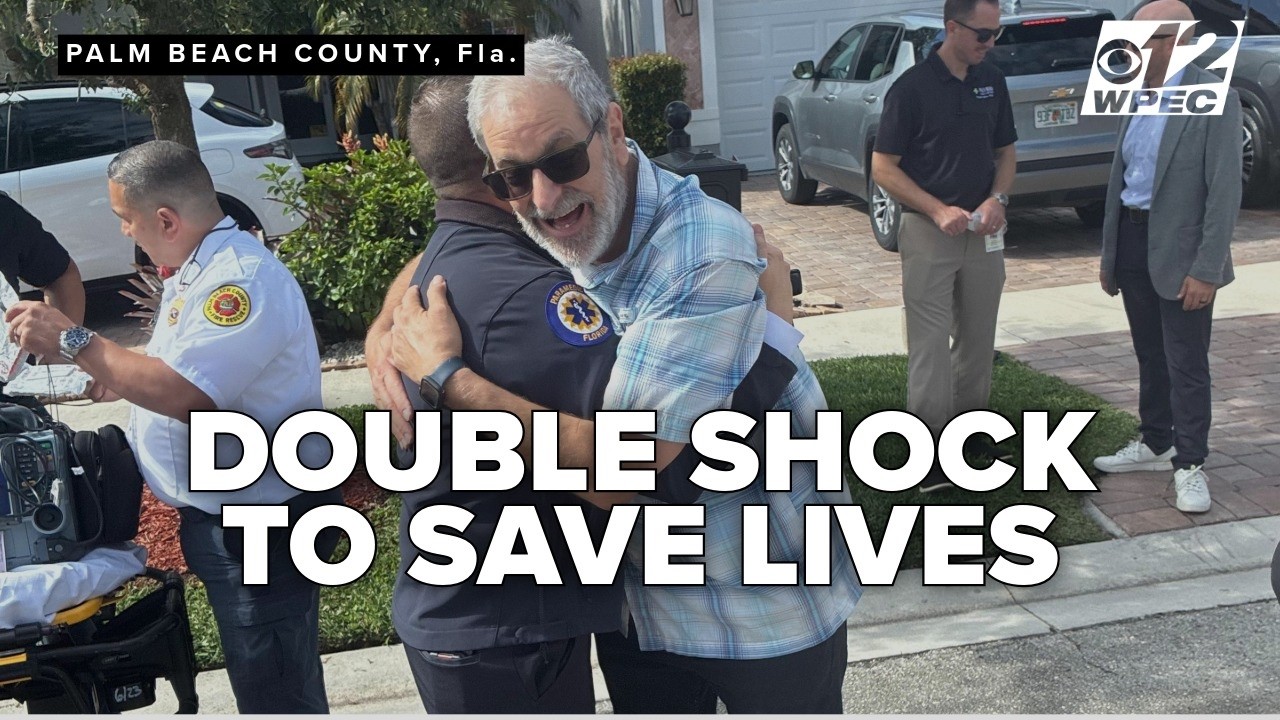
- One patient’s case, in which the protocol was among the department’s first uses of the technique, was later included in a peer-reviewed medical study examining early use of double sequential defibrillation.
PALM BEACH COUNTY, Fla. — Palm Beach County Fire Rescue has implemented a new cardiac arrest protocol allowing first responders to use an advanced defibrillation technique earlier in resuscitation efforts, department officials said.
The technique, known as double sequential defibrillation, uses two defibrillators and four pads: one set placed on the front of the patient’s chest, and a second set positioned slightly off-center on the back to create a separate electrical pathway through the heart. According to EMS Capt. Anthony Robles, the two defibrillators operate independently but deliver the same amount of energy simultaneously, an approach intended to restore a sustainable heart rhythm in patients who do not respond to standard defibrillation.
Fire Chief Charles Coyle said the department developed the protocol using national research and consultation with its medical director staff rather than waiting for further study. “We have to create the protocol to save lives today and not wait for the science to develop tomorrow,” Coyle said. The technique is used within the department’s “pit crew CPR” model, which assigns specific roles to responders during cardiac arrest calls.
The protocol has already been used in the field. In one case, cited by the department as among its earliest uses of the technique, a patient’s heart converted to a sustainable rhythm after crews administered the dual shock, and responders were able to detect a pulse and blood pressure. That case was later included in a peer-reviewed medical study examining early use of double sequential defibrillation for refractory ventricular fibrillation; researchers said the approach may improve outcomes for some patients but noted further study is needed.