Friday, October 23, 2026
Home Blog Page 14

Gig Harbor Fire Department Opens $17.2 Million Training Campus

By MES Dispatch Staff

The Briefing

  • Gig Harbor Fire & Medic One opened a new $17.2 million firefighter training campus June 24, funded through an $80 million capital bond approved by voters in August 2022.
  • The facility includes a five-story, 17,051-square-foot live-fire training tower equipped with propane-fueled training props simulating garage fires, kitchen stoves, sofas, and vehicle fires, along with computer-controlled safety systems.
  • The adjacent two-story support building contains four offices, meeting rooms, classrooms including a “dirty classroom,” decontamination facilities, locker rooms, showers, bunker gear storage, and a 5,152-square-foot apparatus bay.
  • Training Division Chief Scott Corrigan stated that the facility eliminates the need to transport firefighters and equipment to North Bend or central Pierce County for training, reducing travel time and allowing crews to remain in service within the community.
  • The fire department serves approximately 53,000 residents with 144 staff members, including 125 in uniform, fully staffing five of nine stations 24 hours a day, seven days a week.

GIG HARBOR, WASH. — Gig Harbor Fire & Medic One celebrated the opening of a state-of-the-art firefighter training campus June 24 after voters approved an $80 million capital bond in August 2022 to fund the facility and fire station improvements.

Fire Chief Dennis Doan remarked at the grand opening ceremony that the training campus will enhance firefighter decision-making and emergency response capabilities. “There will be a day, many years from now, when a firefighter who was trained in this building makes the right decision at the right moment on the worst day of someone’s life,” Doan stated. “When that day comes, the people they help may not know that this facility had anything to do with it. But we will know.”

The facility cost approximately $17.2 million and occupies 34,069 square feet. The main structure is a five-story training tower measuring 17,051 square feet. The facility was designed to simulate diverse building layouts and fire scenarios that firefighters may encounter in residential, commercial, and industrial structures.

Each floor of the training tower contains specialized rooms configured to replicate different building types. A single room accessed through different doorways and stairwells can simulate garden-style apartments, center-hallway construction such as hospitals or schools, and other residential configurations. The modular design includes removable concrete panels enabling firefighters to reconfigure room layouts to match specific community challenges.

Training Division Chief Scott Corrigan explained the operational advantages of the on-site facility. Previously, firefighters required transportation to North Bend and central Pierce County to access live-fire training. The new campus eliminates travel time and allows crews to remain available for emergency response while training locally.

“We are here, all of our people will be here in case an emergency happens,” Corrigan stated. “And we can cease training and go respond in the community for a major alarm.”

The training tower includes multiple live-fire props allowing realistic practice scenarios. A propane-fueled system permits controlled burns in rooms configured to resemble home garages, kitchen stoves, and household furniture. Computer-controlled safety systems automatically shut off propane if temperatures exceed safe thresholds, allowing firefighters to restore tenable conditions in 60 seconds or less. Emergency stop buttons are installed throughout the building.

Training Lieutenant Max Haas described the technical capabilities. “All of our live fire props have a whole host of computer systems regulating them, so that if they reach a threshold that’s too high, too hot, it’ll shut off the propane,” Haas stated.

The facility also features mobile live-fire props for vehicle fire training. A car prop with integrated propane systems operates on wheels and can be positioned at different locations for realistic fire attack practice.

Additional training areas simulate technical rescue scenarios. A section includes a collapsible floor system permitting crews to practice stabilizing compromised structures and extracting victims from rubble. Vertically aligned floor holes extending from the fifth floor to the basement enable rope rescue training for cliff and embankment scenarios.

The facility includes forcible entry props throughout doorways simulating locked structures firefighters may encounter during emergency operations.

The adjacent two-story support building totals 11,866 square feet. The structure contains four offices, a meeting room, classrooms including a specialized “dirty classroom” where firefighters enter in protective gear for instruction without contaminating other spaces. A dedicated decontamination facility allows firefighters to safely remove and dry gear. Locker rooms, showers, and dedicated bunker gear storage complete the support building, which also incorporates a 5,152-square-foot apparatus bay for fire trucks.

The bond-funded improvements extend beyond the training campus. The August 2022 bond also authorized construction of a replacement fire station on Kimball Drive and improvements to stations in Fox Island, Crescent Valley, Swede Hill, and Artondale.

The capital bond costs the owner of a $500,000 assessed property approximately $9.90 monthly over a 20-year period, based on an estimated 24 cents per $1,000 of assessed property value.

Gig Harbor Fire & Medic One employs 144 staff members, with 125 in uniform. The department fully staffs five of its nine stations 24 hours daily, seven days weekly, serving approximately 53,000 residents across its service area.

Manhattan High-Rise Stabilized After Structural Column Failure; Evacuations Lifted

0

By MES Dispatch Staff

The Briefing

  • A 37-story Manhattan office tower undergoing conversion to luxury apartments at 235 East 42nd Street was stabilized Tuesday evening after structural columns buckled on the 21st and 22nd floors, prompting emergency evacuations of seven nearby buildings.
  • New York City Department of Buildings Commissioner Ahmed Tigani confirmed that intensive monitoring detected no additional movement of the damaged columns after multiple floors were assessed.
  • The former Pfizer global headquarters building experienced sagging floors and multiple cracks; developer MetroLoft attributed the damage to added weight from construction widening the top approximately 15 floors.
  • Structural engineers stated the two buckled columns will require removal and replacement rather than repair, with shoring systems installed as emergency temporary support while repairs proceed.
  • The building remained evacuated during much of Tuesday while emergency personnel conducted structural assessments; the project is characterized as the largest office-to-residential conversion in New York City history with over 1,600 planned units.

MANHATTAN, N.Y. — A major office-to-residential conversion project stabilized its structure Tuesday after discovering buckled columns that prompted widespread evacuations and concerns of potential collapse. By evening, most nearby buildings were permitted to reoccupy.

The building at 235 East 42nd Street, the former global headquarters of pharmaceutical manufacturer Pfizer, experienced structural failure when two load-bearing columns buckled on the 21st and 22nd floors. The incident prompted immediate evacuation of seven nearby buildings, including a school, the Israeli consulate, and several hotels in the midtown corridor near Grand Central Terminal and the Chrysler Building.

Fire Department personnel responded around 8 a.m. Tuesday and documented structural damage including bent columns visible through large glass windows on the 21st floor, multiple cracks, and sagging floors between the 21st and 26th levels.

Ahmed Tigani, commissioner of the New York City Department of Buildings, held a press conference Tuesday evening and confirmed that intensive monitoring and floor-by-floor inspections throughout the day detected no additional movement in the damaged columns. “We’ve been monitoring the building for many hours and have not seen any movement,” Tigani stated.

The stabilization decision allowed work crews to proceed with emergency shoring operations. By Tuesday evening, workers could be observed installing four-legged scaffolding systems designed to temporarily carry the load the failed columns were intended to support until permanent repairs could be completed.

Fire Chief John Esposito addressed concerns regarding potential collapse hazards. Esposito stated that the building’s steel-frame construction design means any failure would likely be localized rather than total collapse affecting the entire structure.

The project, managed by MetroLoft and designed by architectural firm Gensler, is transforming two 1970s-era office buildings into a mixed-use residential complex. Developers characterize the undertaking as the largest office-to-residential conversion in city history, with more than 1,600 residential units planned along with additional new construction atop the existing structure.

MetroLoft founder Nathan Berman told The Wall Street Journal that the added weight from construction work widening the top approximately 15 floors of the building likely caused the structural failure. Berman stated that the two columns that buckled may not have been properly reinforced for the additional loads imposed by the top-floor expansion.

“Why those particular two columns and nothing else? We don’t know. We’re investigating that,” Berman said.

Structural engineers consulted by media outlets stated that the buckled columns are unlikely to be salvageable and will require removal and replacement. Emily Guglielmo, a structural engineer based in California, stated that cracking, deflections, and sagging evident in the damage indicate the affected elements are not repairable.

Column replacement will require rigorous structural analysis and extensive repairs, engineers stated. The immediate emergency response involves shoring systems that temporarily support building loads until the permanent repair work begins.

Professor Abi Aghayere from Drexel University’s structural engineering program explained that shoring provides temporary four-legged scaffolding to carry loads until damaged columns can be replaced and structural integrity restored.

Associate Professor Yi Bao at Stevens Institute of Technology cautioned that damage may extend beyond the two visible buckled columns, with loads potentially redistributed to other portions of the structure requiring additional evaluation.

City building department records indicate the project previously received multiple safety violation citations, including incidents involving falling glass and metal debris and a worker fall from a ladder.

MetroLoft maintained in a statement that building structural integrity remains sound. “Ninety-five percent of the building, the structure is sound and intact. There is no way that this corner of a small extension all of a sudden topples this building,” Berman stated.

Rockland Paramedic Services Deploys Cyanokit to Treat Cyanide Poisoning in Fire Victims

By MES Dispatch Staff

The Briefing

  • Rockland Paramedic Services expanded its advanced life support capabilities by deploying 14 Cyanokits to treat cyanide poisoning in smoke inhalation patients from enclosed-space fires.
  • The antidote uses hydroxocobalamin, a form of vitamin B12 that binds to cyanide so it can be eliminated from the body, allowing paramedics to initiate treatment at the scene before hospital arrival.
  • Smoke inhalation causes the majority of residential fire deaths, and research has documented cyanide poisoning involvement in many enclosed-space fire injuries and fatalities.
  • Firefighters face exposure to dangerous cyanide levels during structure fires, making rapid field treatment critical to improving patient outcomes.
  • Because no rapid field test exists for cyanide poisoning, trained paramedics rely on fire conditions, patient symptoms, and clinical indicators to determine when treatment is appropriate.

ROCKLAND COUNTY, N.Y. — Rockland Paramedic Services has expanded prehospital treatment capabilities for fire victims by equipping its fleet with 14 Cyanokits, allowing paramedics to treat suspected cyanide poisoning at the scene before hospital transport.

The addition of Cyanokit strengthens the agency’s advanced life support program and reflects continued investment in evidence-based treatment and paramedic training. Executive Director Tim Egan stated that the deployment represents the agency’s ongoing commitment to providing the highest level of emergency medical care to Rockland County residents and firefighters.

Cyanokit uses hydroxocobalamin, a form of vitamin B12, to bind with cyanide in the bloodstream, allowing the toxic compound to be eliminated from the body. The treatment permits paramedics to initiate therapy in the field, potentially improving survival rates for fire victims and firefighters exposed to smoke.

Research has established that smoke inhalation accounts for the majority of residential fire deaths. Studies have documented that cyanide poisoning plays a significant role in injuries and fatalities resulting from enclosed-space fires, where combustion of synthetic materials produces toxic byproducts including hydrogen cyanide.

Firefighters responding to structure fires face the risk of exposure to dangerous cyanide levels, making rapid treatment critical. The deployment of Cyanokit across Rockland Paramedic Services’ fleet ensures the antidote is available for immediate field use.

Egan emphasized paramedic training as essential to the program. “Our paramedics continually train on the latest lifesaving techniques and technologies so they are prepared to provide the most advanced care possible when seconds count,” Egan stated.

Because no rapid field diagnostic test exists for cyanide poisoning, trained paramedics rely on clinical decision-making based on fire scene conditions, visible patient symptoms, and objective medical indicators to determine when Cyanokit administration is warranted.

Convenience Store Industry Honors First Responders on 24/7 Day With Free Drinks and Snacks

0

By MES Dispatch Staff

The Briefing

  • The National Association of Convenience Stores and National Emergency Number Association partnered Thursday to recognize first responders on 24/7 Day, July 24, 2025, celebrating law enforcement, firefighters, paramedics, and 911 professionals who work around the clock.
  • Thousands of convenience store locations nationwide offered free coffee, fountain drinks, frozen beverages, or snacks to uniformed first responders and those displaying work badges.
  • The 2025 24/7 Day initiative marked the continued commitment by the convenience store industry to recognize and support first responders throughout the year.
  • Convenience stores remain vital community hubs, operating 24/7 to serve emergency personnel and the public during crises and disasters.
  • A full list of participating store locations and specific offers was available at conveniencecares.org, with a searchable map to help first responders find nearby participating retailers.

WASHINGTON — The convenience store industry united Thursday to recognize first responders serving communities around the clock through the annual 24/7 Day celebration, with thousands of store locations nationwide offering complimentary beverages and snacks to uniformed personnel and those displaying work credentials.

The National Association of Convenience Stores partnered with the National Emergency Number Association to honor first responders including police officers, firefighters, emergency medical technicians, paramedics, emergency room physicians, nurses, 911 professionals, and American Red Cross volunteers.

Participating convenience store retailers offered free coffee, fountain drinks, frozen beverages, or snacks to first responders displaying uniforms or official work badges. The NACS Foundation emphasized that convenience stores function as vital community hubs, particularly during emergencies when many other businesses close.

The 2025 24/7 Day initiative underscored the convenience store industry’s year-round commitment to supporting and recognizing first responders for their dedication to protecting communities. The event celebrates personnel who work 24 hours a day, 7 days a week, 365 days per year in service to their communities.

A comprehensive list of participating store partners and their specific offers was compiled at www.conveniencecares.org. The organization provided an interactive map enabling first responders to identify nearby participating locations and confirm available offers.

The NACS Foundation encouraged social media participation using hashtags #247day, #ThankYou911, and #ConvenienceCares to show appreciation for first responders answering calls every day and every hour throughout the year.

Salisbury Collective Bargaining Repeal Faces Voter Referendum After Petition Drive

0

By MES Dispatch Staff

The Briefing

  • Organizers submitted 6,223 petition signatures Monday to Salisbury, Maryland, to force a voter referendum on the City Council’s May repeal of collective bargaining rights for firefighters, police officers, and municipal employees.
  • The signature count exceeded organizers’ estimated threshold by 54% and requires validation against a 20% threshold of qualified city voters to block the repeal pending referendum approval.
  • Salisbury City Council voted 3-2 in May 2026 to repeal collective bargaining after the city granted the right in 2022; Mayor Randy Taylor cited unsustainable labor costs comprising 70% of the city budget.
  • The petition campaign, organized by labor supporters including unions AFSCME Maryland Council 3 and IAFF Local 4246, collected signatures in 37 days from more than 100 volunteers including firefighters, local officials, and civic organizations.
  • Salisbury’s next municipal election is scheduled for November 2027; city officials will determine whether the referendum question can appear on the general election ballot or a special election must be called.

SALISBURY, MD. — Organizers fighting to preserve collective bargaining rights for Salisbury municipal workers submitted 6,223 petition signatures Monday to force a voter referendum on the City Council’s repeal of negotiating protections for firefighters, police officers, and city employees.

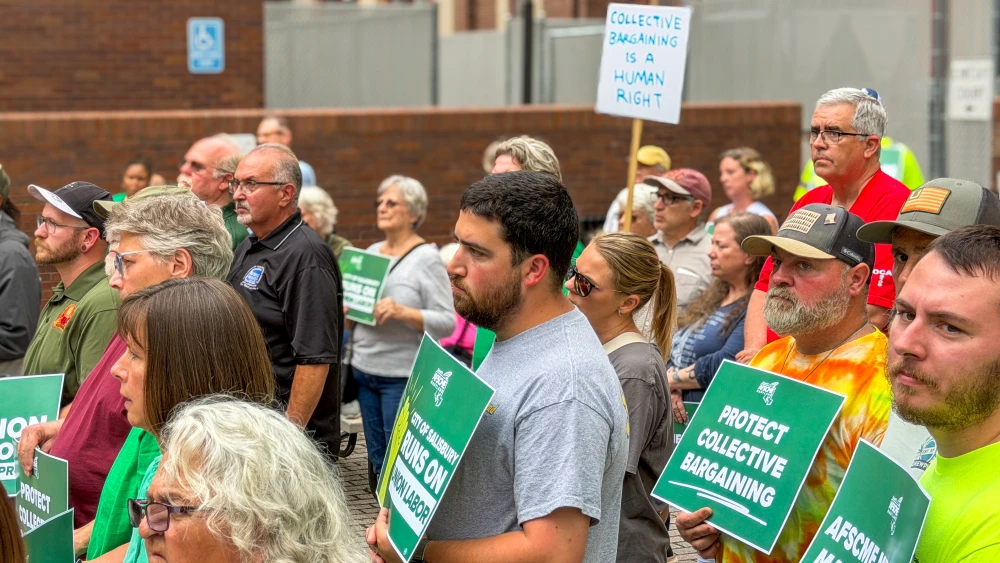
About 100 people protested outside the government center Tuesday, May 26, 2026 before the Salisbury City Council voted to repeal collective bargaining rights for city workers.
Josh Davis/TNS

Jared Schablein, an organizer of the petition campaign, stated that the signature total significantly exceeded what campaign leadership believed was required. “People want this. And we’re excited for this to go on the ballot,” Schablein said.

The petition submission potentially blocks the City Council’s repeal from taking effect pending voter approval of the proposal. However, the signatures must be validated against state legal requirements. Maryland law requires petition signatures to total at least 20% of qualified city voters within Salisbury’s jurisdiction.

Salisbury City Council granted collective bargaining rights to firefighters, police officers, and general government workers across city departments in 2022. On May 27, 2026, the council voted 3-2 to repeal that provision following weeks of tense debate regarding municipal labor relations and budgetary constraints.

Mayor Randy Taylor characterized existing collective bargaining agreements as financially unsustainable. Taylor stated that labor costs represent approximately 70% of the city budget and that agreements providing 6% annual raises exceeded Salisbury’s average annual revenue growth of approximately $2 million annually.

The petition campaign mobilized more than 100 volunteers over a 37-day period. Volunteers included union members, retired and off-duty firefighters, local elected officials, and members of civic organizations across Salisbury.

Brandon Records, president of Salisbury Career Firefighters Local 4246, characterized the petition effort as reflecting citizens’ actual preferences. “The IAFF and AFSCME have put in the work and completed this first step,” Records said. “We now look forward to keeping our momentum to the polls at election time.”

AFSCME Maryland Council 3 expressed confidence that petition signatures exceeded the legal threshold. “Thousands of Salisbury’s voters have made their voices heard through this petition effort, and it’s clear that the people of this community overwhelmingly support our city workers,” the union stated.

Mayor Taylor confirmed that the City Clerk’s Office is reviewing petitions. “The mayor’s office will report when more information is known,” Taylor said.

Schablein rejected prior criticism from Mayor Taylor regarding the petition campaign, including complaints concerning paid canvassers originating from outside Maryland. “The mayor can say what he wants,” Schablein stated. “The people of Salisbury stand with our first responders and city workers.”

Salisbury’s next scheduled municipal election is November 2027. State law permits the City Council to schedule the referendum during the next regular election or call a special election. Schablein stated that it remains unclear whether the question could appear on the general election ballot this November 2026.

New York City Seeks Dismissal of 9/11 Air Quality Records Lawsuit

0

By MES Dispatch Staff

The Briefing

  • New York City’s Law Department filed a motion to dismiss a Freedom of Information Law lawsuit seeking documents regarding air quality and toxin hazards at Ground Zero following September 11, 2001, claiming no responsive records were found.
  • Mayor Zohran Mamdani announced $34 million in budget allocations for creating a public portal providing access to post-9/11 air quality and health documents, with initial releases scheduled before the 25th anniversary of 9/11 in September 2026.
  • Attorney Andrew Carboy filed the FOIL lawsuit on behalf of 9/11 Health Watch, survivors, and families of individuals who died from 9/11-related illnesses, seeking information about what city officials knew about Ground Zero dangers and when they became aware.
  • The city’s Department of Environmental Protection previously claimed to possess no documents on 9/11 toxins, then discovered 68 boxes of materials in November 2025 during a remodeling project at the agency’s offices.
  • More than 9,000 people have died from 9/11-related illnesses, nearly triple the 2,977 deaths occurring on September 11, 2001.

NEW YORK — New York City’s Law Department filed a motion to dismiss a Freedom of Information Law lawsuit seeking disclosure of documents regarding air quality hazards and toxic contaminants detected at Ground Zero in the days following September 11, 2001.

City attorneys argued that the mayor’s office and the Law Department conducted reasonable searches but located no responsive records. The city also contended the lawsuit was premature because document review remains ongoing and the city requested a continuance that plaintiffs refused to grant.

“The city has committed to reviewing millions of documents and releasing information to the public to provide answers that have been lingering for nearly 25 years, but that cannot happen overnight,” mayoral spokesman Sam Raskin stated.

Attorney Andrew Carboy filed the FOIL request three years prior on behalf of 9/11 Health Watch, survivors, and families of individuals who died from illnesses related to exposure to World Trade Center toxins. The lawsuit seeks to determine what city officials knew about Ground Zero air quality dangers and when they learned that information.

Mayor Mamdani announced that $34 million was added to the city’s budget to create an online portal for public access to documents regarding post-9/11 air quality and health risks. Mamdani stated the first documents will be available by September 25, 2026, the 25th anniversary of the attacks.

“For too long, New Yorkers who have become sick have had to fight for information that should have been theirs from the very beginning,” Mamdani said. “We will provide the transparency that New Yorkers living with post-9/11 health concerns deserve.”

Carboy expressed skepticism regarding the city’s dismissal motion and portal announcement. The city’s Department of Environmental Protection previously claimed to possess no 9/11 toxin documents, then discovered 68 boxes of materials in November 2025 during an office remodeling project.

“After years of delaying Congressional inquiries and requests for documents from 9/11 Health Watch, the mayor’s office needs additional time? They need to get their stories straight,” Carboy stated.

Carboy characterized the city’s reasoning as contradictory. “The current administration is treating the public like morons. The days and months after 9/11 were the most successful part of Mayor Giuliani’s career, and the official position of the Mayor’s office is that none of those records exist?”

Benjamin Chevat, executive director of 9/11 Health Watch, expressed conditional support for the mayor’s transparency initiative while raising concerns. “We would be happy to applaud the mayor’s action, but we still have questions concerning the Law Department’s intentions. We remain hopeful that Mayor Mamdani can answer: what did the city know about health hazards posed by World Trade Center contaminants and when did it learn that information?”

Every mayor between Rudolph Giuliani and Eric Adams fought requests for release of 9/11 studies and documents, claiming the materials could not be located. City officials previously cited concerns that releasing documents would trigger litigation by survivors and first responders suffering from 9/11-related illnesses.

More than 9,000 people have died from illnesses attributed to exposure to World Trade Center toxins and contaminants, according to Centers for Disease Control data.

The U.S. Center for Disease Control’s WTC Health Program has enrolled more than 140,000 first responders and survivors. Approximately 81,000 have certified conditions linked to World Trade Center exposure.

Most enrolled participants have not filed lawsuits because they have already signed waivers agreeing not to pursue legal action in exchange for benefits provided through the WTC Health Program and the 9/11 Victim Compensation Fund, according to city officials.

Manhattan Office-to-Residential Conversion Evacuated After Structural Columns Buckle

0

By MES Dispatch Staff

The Briefing

  • FDNY and city officials evacuated a 37-story Manhattan office tower undergoing conversion to luxury apartments Tuesday after structural columns buckled on the 21st and 22nd floors, causing bricks to fall into Midtown streets during morning rush hour.
  • The former Pfizer global headquarters at 235 East 42nd Street, located near the Chrysler Building and Grand Central Terminal, experienced sagging floors between the 21st and 26th levels; the building remained unstable and continued moving as emergency personnel assessed structural integrity.
  • A nearby school housing approximately 400 children and surrounding buildings were evacuated; all construction workers inside the office tower were accounted for with no reported injuries.
  • Engineers deployed drones to monitor the building rather than sending personnel inside; the planned residential conversion, designed by architectural firm Gensler, is billed as the largest office-to-residential conversion in city history with more than 1,600 units planned.
  • Mayor Zohran Mamdani and FDNY Chief John Esposito characterized the incident as extremely serious and dangerous, with nearby streets closed to pedestrian and vehicular traffic.

NEW YORK — FDNY and city officials evacuated a major office tower undergoing residential conversion Tuesday morning after discovering that two structural columns had buckled, causing debris to fall into Midtown Manhattan streets during the morning rush hour.

Fire Department personnel received reports of falling bricks around 8 a.m. from the 37-story tower located at 235 East 42nd Street. Emergency responders discovered that columns had buckled on the 21st and 22nd floors, and floors were sagging between the 21st and 26th levels.

The building is the former global headquarters of pharmaceutical manufacturer Pfizer and is being converted to luxury residential apartments as part of a major mixed-use development project. The conversion project, led by architectural firm Gensler, is characterized as the largest office-to-residential conversion in city history. The planned complex includes more than 1,600 residential units along with additional new construction atop the existing structure.

Mayor Zohran Mamdani held a press conference at the scene and characterized the situation as extremely serious. “The building remains unstable. This is an extremely serious situation,” Mamdani said.

FDNY Chief John Esposito confirmed the ongoing structural instability. “It is not yet stable. It is still a very serious and dangerous situation,” Esposito stated, noting that the building has continued to shift and move as emergency personnel have been on scene.

All construction workers inside the office tower were accounted for, and no injuries were reported. A nearby school housing approximately 400 children was among the buildings evacuated. Additional surrounding structures were also evacuated as a precautionary measure.

Engineers are working to stabilize the damaged floors and assess structural integrity. The city is deploying drones to monitor the building, reducing the necessity to send personnel inside to conduct manual inspections of compromised structural areas. Nearby streets have been closed to both pedestrian and vehicular traffic.

The city’s Department of Buildings has assigned inspectors and engineers to assess the situation. Officials stated that public safety remains the top priority as crews work to stabilize the structure and determine the cause of the column failure.

New Mexico Search and Rescue Teams Underutilized as Law Enforcement Delays Requesting Specialized Assistance

By MES Dispatch Staff

The Briefing

  • New Mexico’s more than 40 volunteer search and rescue teams are being deployed less frequently despite a rising number of incidents requiring rescue services, with response rates declining from 76% in 2023 to 40% as of mid-June 2026.
  • Resource Officer Bob Rodgers cited cases where county sheriffs and local law enforcement agencies delayed requesting SAR assistance by hours or days, waiting until initial search efforts proved unsuccessful before calling in specialized teams.
  • Air Force Major General William McCasland disappeared from his Albuquerque home in late February; Bernalillo County Sheriff’s Office did not request SAR assistance until two days after his overdue report, and McCasland remains missing.
  • A 2025 amendment to the state Search and Rescue Act requiring first responders to notify state police when incidents involve “lost, stranded, entrapped or injured persons” took effect in 2026 but has not increased SAR deployment.
  • Volunteer leaders stated that SAR teams provide specialized expertise in advanced land navigation, wilderness survival, and technical rope rescue that local law enforcement typically lack, while keeping costs to the state minimal at approximately $200 per mission.

ALBUQUERQUE, N.M. — New Mexico’s volunteer search and rescue teams continue to be called to fewer operations despite rising incident frequencies, prompting SAR leaders to attribute the decline to reluctance among county sheriffs and local law enforcement to request state assistance.

Bob Rodgers, resource officer for New Mexico Search and Rescue since 2011, documented response data showing a sharp decline in SAR deployment. In 2023, volunteer teams responded to 76% of 149 incidents. By 2024, response rates fell to 50% of 187 incidents. The 2025 rate recovered slightly to 55% of 191 incidents, but declined to 40% of 75 incidents as of June 10, 2026.

“Throughout the state of New Mexico, the volunteers are being called less and less to participate in search and rescue incidents,” Rodgers stated. “Fire departments, county sheriffs, feel they can do it without us, and if they get into a problem, they’re waiting two or three hours, if not days, before they finally realize they needed SAR.”

As the law enforcement arm of the Department of Public Safety, New Mexico State Police possess authority to deploy search and rescue teams. However, county and local law enforcement agencies—typically first responders—often choose not to request state assistance, according to Rodgers.

He cited the case of retired Air Force Major General William McCasland, who disappeared from his Albuquerque residence in late February. The Bernalillo County Sheriff’s Office did not request search and rescue assistance until two days after his report was overdue. McCasland has not been located.

Rodgers stated that delays in mobilizing appropriate resources for missing person searches significantly reduce successful outcome chances.

Similar patterns emerged elsewhere in the state. In March, Taos Search and Rescue President Delinda VanneBrightyn reported that the Taos County Sheriff’s Office delayed contacting the Department of Public Safety to dispatch volunteers after two teenagers became trapped at the bottom of Rio Grande Gorge. VanneBrightyn stated the organization “had a very hard time getting search and rescue involved.”

Taos County Sheriff Steve Miera was unavailable for comment. Previously, he stated intentions to train deputies in search and rescue techniques. For years, his staff has overseen responses at Rio Grande Gorge Bridge, the site of numerous suicides and missing person cases.

VanneBrightyn, a volunteer for more than 20 years specializing in K-9 search and rescue, emphasized that law enforcement benefits from SAR’s specialized expertise. “We should be having many more missions,” she stated. “The sheriffs are now doing this across the state.”

A 2025 amendment to the state Search and Rescue Act requiring first responders to notify state police when incidents involve “lost, stranded, entrapped or injured persons” took effect in 2026. However, state data suggests volunteer teams remain underutilized in 2026.

Declining mission numbers have prompted volunteer team membership losses as volunteers find training hours rarely translate into operational deployment.

VanneBrightyn expressed frustration with the situation. “It has been frustrating because the sheriff doesn’t have the resources, the trained resources that we have. They are law enforcement.”

The decline in New Mexico search and rescue missions dates to 1996, when 191 missions involved 4,004 personnel and 22,602 field hours, according to records. Rodgers noted that older state data reliability is less certain than more recent records.

Grant County Search and Rescue President Russ Imler suggested that declining missions may relate to advanced wayfinding technologies, including GPS devices and smartphones. “The electronics that people carry nowadays, people aren’t getting as lost,” Imler stated.

Rodgers emphasized the cost-effectiveness and specialized capabilities SAR teams provide. Teams possess advanced land navigation, wilderness survival, and technical rope rescue expertise law enforcement agencies typically lack. SAR operations cost approximately $200 per mission—expenses covering logistics only, without salary, overtime, or food costs. Rodgers stated a 30-person team can operate autonomously for 24 hours without external support.

New Jersey Legislature Recognizes Open Water Lifeguards as First Responders

0

By MES Dispatch Staff

The Briefing

  • The New Jersey State Senate unanimously passed a resolution on June 30 formally recognizing approximately 3,000 open water lifeguards patrolling 123 miles of coastline as first responders and emergency response providers.
  • The designation grants lifeguards access to state emergency responder programs and benefits including emergency responder insurance, line-of-duty death benefits for surviving families, and vaccination access during communicable disease outbreaks.
  • The resolution honors two lifeguards who died in the line of duty in 2021: Norman Inferrera, 16, whose patrol boat overturned in Cape May, and Keith Pinto, 19, struck by lightning while working at South Seaside Park beach.
  • Lifeguards in New Jersey receive specialized training in emergency medical care, marine firefighting, and rescue watercraft operations comparable to other emergency response professionals.
  • The recognition positions lifeguards to benefit from the New Jersey First Responders Post-Traumatic Stress Disorder Protection Act signed into law earlier in 2026.

TRENTON, N.J. — The New Jersey State Senate unanimously passed a resolution formalizing recognition of open water lifeguards as first responders and emergency response providers, granting them access to state emergency services benefits and protections.

The measure, designated SR72, passed on June 30 following introduction in February by Senator Vin Gopal, the bill’s prime sponsor. The resolution recognizes the approximately 3,000 lifeguards who patrol New Jersey’s 123 miles of coastline.

The new designation extends emergency responder benefits to lifeguards previously unavailable to civilians. Benefits include priority access to emergency responder insurance coverage, line-of-duty death benefits available to surviving family members, and eligibility for vaccinations during future communicable disease outbreaks.

Gopal characterized lifeguards as critical emergency response personnel. “Every day, lifeguards stand ready to put themselves in harm’s way to protect others. They are often the first to respond in emergencies, making split-second decisions that save lives and keep our beaches and waterways safe.”

Lifeguards in New Jersey receive specialized training in emergency medical care, marine firefighting, law enforcement support, and rescue watercraft operations—qualifications comparable to those of other emergency response professionals. Supporters of the resolution emphasized that the training and responsibilities of lifeguards align them with traditional first responder roles.

The resolution honors two New Jersey lifeguards killed in the line of duty in 2021. Norman Inferrera, 16, from Phoenixville, Pennsylvania, was a first-year lifeguard assigned to Cape May when his patrol boat overturned in rough surf on August 19, 2021. Inferrera was knocked unconscious when he struck his head on the boat and died two days later at Cooper University Medical Center in Camden.

On August 30, 2021, Keith Pinto, 19, a South Seaside Park beach lifeguard and 2020 Toms River High School North graduate attending Ocean County College, was struck by lightning while working at 21st Avenue Beach and died from his injuries.

Mat Giachetti, founder of Howell-based LifeForce USA, a training center affiliated with the American Heart Association, American Health & Safety Institute, National Safety Council, and American Red Cross, collaborated with officials from the United States Lifesaving Association to help draft the proposal.

“We respond to emergencies, treat injured victims, provide emergency assistance and transport people to safety,” Giachetti stated, noting that lifeguards already performed the core duties of emergency responders.

The resolution supports efforts to address persistent lifeguard shortages, particularly in mid-August when teachers return to classrooms and college students leave employment. Supporters indicated that formal recognition as first responders would enhance recruitment and retention efforts.

Lifeguards will benefit from the New Jersey First Responders Post-Traumatic Stress Disorder Protection Act, which Governor Phil Murphy signed into law earlier in 2026. The act provides employment protections for paid first responders diagnosed with work-related PTSD under specified conditions. Previously, the law applied exclusively to firefighters, emergency medical technicians, paramedics, dispatchers, and law enforcement officers.

Giachetti noted that lifeguards will now be included in workplace PTSD protections as a result of the first responder designation.

Fire Breaks Out on Brooklyn Bridge During July Fourth Fireworks; No Injuries Reported

0

By MES Dispatch Staff

The Briefing

  • A fire erupted on the Brooklyn Bridge in New York during the city’s July Fourth fireworks display, generating flames and smoke before FDNY crews extinguished the blaze using two fire engines.
  • The Brooklyn Bridge was closed to traffic during the fireworks show when the fire occurred, and no injuries were reported.
  • An FDNY spokesperson stated that such fires during fireworks are not unexpected and that crowd control measures remain in place to distance spectators from potential ignition sources.
  • The July Fourth fireworks show was moved earlier than originally scheduled due to forecasts of severe weather that canceled and delayed celebrations along the East Coast, including in Washington, where crowds were evacuated from the National Mall.
  • Firefighters doused the flames shortly before 10 p.m. as the celebration continued.

NEW YORK — Fire broke out on the Brooklyn Bridge during New York City’s Independence Day fireworks celebration, generating flames and smoke that FDNY personnel extinguished using two fire engines.

The fire occurred on the bridge, which had been closed to vehicular traffic during the fireworks display. Firefighters were observed suppressing the blaze shortly before 10 p.m. as the show proceeded.

An FDNY spokesperson stated that fires during fireworks exhibitions are not unexpected occurrences. The department noted that such incidents inform standard procedures requiring crowds to be maintained at a distance from fireworks operations to mitigate ignition risks.

No injuries were reported.

The July Fourth fireworks display was scheduled earlier than originally planned due to severe weather forecasts affecting celebrations throughout the East Coast. In Washington, weather threats prompted evacuation of crowds assembled on the National Mall.