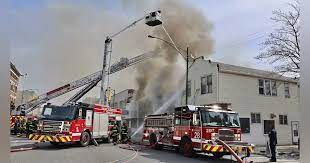
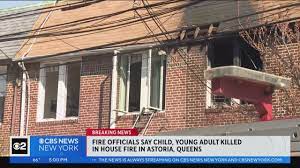
A 7-year-old boy and his 19-year-old sister died Monday afternoon in Astoria, Queens, after they were trapped in their second-floor apartment when an e-bike battery burst into flame, blocking the only exit from their residence, according to the FDNY.
The children’s father, Salah Ahmed Alyafi, and their four siblings escaped the blaze by leaping from the windows after a lithium-ion battery set to charge in the vestibule on 46th St. near 28th Ave. ignited just after 2 p.m., according to fire officials.
Neighbor Teddy Alafogiannis, 34, heard cries for help and rushed to aid the devout Muslim family.
“I was in my living room and I heard someone screaming and I heard, ‘Help, my house! Help, my house!’” said Alafogiannis.
He said that the father and one of his sons were at the window trying to escape the heavy smoke.
“I came outside, my two neighbors already outside. So we got to find a ladder to get these people out the back windows,” Alafogiannis recounted. “We couldn’t find a ladder so we just told him to jump. We caught them.”
The father, twin boys and a 7-year-old girl were rescued, according to Abdul Mubarez, president of the Yemeni American Merchants Association. The girl’s twin brother and the oldest daughter died in the fire. The mother of the children was not at home when the blaze broke out.
“They were getting to break the fast [for Ramadan],” family friend Saddam Mubarez said. “It’s really, really sad.”
It took just three minutes for the Fire Department to arrive, but by that time, it was too late.
“The cause of the fire was an e-bike. It created a heavy smoke condition at the first-floor level that was able to travel directly up the stairs,” FDNY Chief John Hodges told reporters.
“If this was not an e-bike fire, we would have been able to put this fire out without incident, but the way that these e-bike fires occur, it’s like an explosion of fire and these occupants had very little chance of escaping.”
It took 25 units with 106 firefighters about an hour to bring the fire under control around 3:15 p.m., according to the FDNY.
This is the 59th fire in the five boroughs caused by lithium-ion batteries that have suddenly ignited, according to Chief Fire Marshal Dan Flynn. The children account for the city’s fourth and fifth fatalities for the year caused by lithium-ion batteries catching fire. Last year, there were six deaths from 220 such fires in total.
“We want people to use them, but we want them to use them safely,” Flynn said, adding that officials believe that the charger being used was not compatible with the battery.
The father works in the Diamond District and is an inventor, Mubarez said. He has a patent pending for a razor to use in prison that could not be turned into a weapon.
The dad is a “hardworking man trying to make a living and raise his family in this great city,” Mubarez said.
The FDNY commissioner has sounded the alarm that lithium-ion batteries can be dangerous, especially when they are tampered with or used with after-market chargers.
“We are imploring users to follow all manufacturer safety guidelines and recommendations,” she added.
“We are also calling on our federal, state and local partners to move quickly on regulations that will help ensure tragedies like today’s fire are prevented. We are heartbroken for the family of these victims.”
Anthony Maiolo has been serving the Lodi, NJ, community for 25 years as a volunteer firefighter at Lodi Fire Company 1 and would like to serve another 25 years.
He comes from a long line of volunteer firefighters, but life took a pause when he was hit with Type 2 diabetes in 2007, a below-the-knee amputation in 2019 and most recently, kidney disease in 2020.
“It’s been an up-and-down journey,” he told CBS 2 NY. “It’s not something you can just put a Band-Aid on, but it’s a part of life, right now, for me.”
Maiolo’s kidneys are failing and he does dialysis three times a week.
“It’s very hard for me to come out and ask for help,” he said.
Despite a public plea and many friends and family stepping up, no matches were found for a kidney donor.
Until a friend’s fiancée got tested.
“She ended up being a direct match,” Maiolo said, fighting back tears.
A date has not yet been set for the surgery.
Maiolo has a message for possible organ donors.
“Help someone to live the rest of their life. It means a lot for someone to step up and help me. If you could do that for someone, that is one of the greatest gifts you can give somebody.”
April 7, 2023 Conway Fire Department’s Swiftwater Rescue Team made the ice rescue from Sabbaday Falls.
By Brendan Rascius Source The Charlotte Observer (TNS)
A man fell into an icy waterfall in New Hampshire, prompting a high-stakes rescue effort involving bystanders and firefighters, officials said.
The man, who has not been identified, fell into Sabbaday Falls and became pinned by an ice shelf on April 6, according to a news release from the Conway Fire Department.
People nearby offered assistance, preventing the man from becoming fully submerged in the frigid water, officials said.
“By the time first responders arrived, he had been in the water up to his neck for about 45 minutes and was experiencing hypothermia,” according to WMUR.
Rescue swimmers entered the water and were able to free the man using ropes, officials said, calling it a “dramatic swift water rescue.”
“We were actually saying it’s an ice rescue, a swift water rescue and a high-angle rescue all at once,” Conway Fire Chief Stephen Solomon told WMUR. “We are very well versed in swift water rescue. We do numerous swift water rescues every year.”
Sabbaday Falls, located in New Hampshire’s White Mountains, is a popular location to visit, according to the U.S. Forest Service. Swimming at the falls is not permitted.
April 7, 2023 After four suicides and two more attempts, Dallas-Fire Rescue is implementing new measures as part of aim to prevent additional tragedies.
According to Dallas Fire-Rescue, six Dallas firefighters have attempted suicide since 2018. Four of them died.
In their honor, the department and union are pushing for improved mental health resources.
“We don’t know what’s going on inside people’s heads,” Jim McDade, President of the Dallas Fire Fighters Association told WFAA. “One of the members of the department that committed suicide was my best friend.”
Capt. Kenny Crutcher took his own life on Nov. 13, 2021.
“With Kenny — with a lot of these guys — we didn’t see it coming,” McDade said.
Since Crutcher’s death, two Dallas more firefighters killed themselves, and another two others attempted suicide.
“The number two killer of firefighters right now is suicide, and it’s a scary thought,” said McDade.
According to the National Fallen Firefighters Foundation, suicide is three times more likely to happen to firefighters than a line-of-duty death.
Together, Dallas Fire-Rescue and the Dallas Fire Fighters Association are pushing to prevent suicide and promote mental health awareness.
Through their efforts, here’s what the department now offers its firefighters
Peer support is available with 60 to 70 trained peers
DFFA offers three free months of counseling
Paid mental health leave through the City of Dallas
Single-function paramedics are hired to reduce the call volume for firefighter-paramedics
A psychologist is on staff (the goal is to eventually have three psychologists total for the department)
A resiliency coordinator is available
The chaplaincy program is available
All these efforts are to honor those they’ve lost to suicide.
Apr. 7—Firefighters early Friday rescued three people near downtown Houston who were trapped when Buffalo Bayou began rising during a storm.
Emergency responders received a call from three people after 4 a.m. who had taken refuge under a bridge near Smith and Preston streets when the water in Buffalo Bayou began to rise rapidly, Hunter Chappeaux, a district chief for the Houston Fire Department, told Metro Video Services. Firefighters arrived and lowered a ladder to the three men, who were able to climb out.
April 7, 2023 Roseville firefighters treated the CHP officer for gunshot wounds to the chest and hand.
By Michael McGough, Rosalio Ahumada, Molly Jarone Source The Sacramento Bee (TNS) Distributed byTribune Content Agency, LLC.
A man shot a California Highway Patrol officer Thursday at a Roseville park, then shot two additional people he had taken hostage, leaving one of the hostages dead and the other injured, before ultimately surrendering to law enforcement and being taken to a hospital, authorities said.
Roseville police responded shortly after 12:30 p.m. to a call from CHP reporting one of its officers had been shot at Mahany Park, Capt. Kelby Newton of the Roseville Police Department said in a news conference.
The suspect took two adult victims hostage at the park for a short time, until officers arrived and confronted him, Newton said.
The suspect allegedly shot both hostages. One of the hostages died at the scene, Newton said. The other was taken to a hospital, where their condition was not known as of Thursday afternoon.
The suspect surrendered to officers and was taken into custody, Newton said, before also being taken to a hospital for unspecified injuries. Newton said it did not appear the suspect had been shot.
“One of our officers was struck by gunfire from the suspect’s firearm,” CHP Officer Ricardo Ortiz said. “That officer is being treated for his injuries and is in stable condition.”
Newton said CHP was serving an arrest warrant at the time of the incident, but the nature of the warrant was not clear.
Ortiz said he had no other information available regarding the investigation, which remains active.
The shooting and hostage situation developed quickly, in a matter of minutes of police responding to the scene, Newton said.
“It was a rapidly evolving situation and occurred within a couple of minutes of the initial broadcast of the CHP officer being struck by gunfire,” the police captain said.
The identities and ages of the suspect and victims have not been released.
The incident drew a large police presence to the park on Pleasant Grove Boulevard beginning around 12:30 p.m.
The Roseville Police Department in a social media post just after 3:05 p.m. said the “suspect has been taken into custody and the scene is safe and no longer active.”
Dozens of law enforcement vehicles from multiple agencies remained at the scene as of 3:15 p.m. Activity centered on the park, which includes softball fields and a dog park.
The Sacramento County Sheriff’s Office assisted with the response, spokesman Sgt. Amar Gandhi said. Gandhi said “major” law enforcement activity was underway.
Placer County sheriff’s deputies were also at the scene. Pleasant Grove Road was closed to traffic between Woodcreek and Del Webb boulevards as of 2:30 p.m.
SHOOTING PROMPTED LOCKDOWNS, INCLUDING NEAR FIRE STATION
Police were using armored vehicles to attempt to contact a shooter as of 1:15 p.m. at a location near Mahany Park, according to dispatch radio traffic.
Multiple ambulances were also responding to the scene, according to radio traffic. The suspect was taken into custody shortly before 1:25 p.m., according to scanner audio.
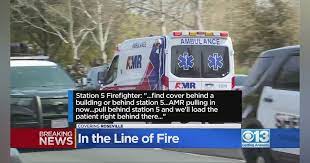
An officer announced over the radio at 12:34 p.m. that shots were first fired at Mahany Park. The officer was in pursuit. Firefighters at Roseville Fire Department Station 5, adjacent to the park, reported active gunfire near the station, according to scanner traffic.
City parks and recreation personnel were hunkered down, taking shelter near the fire station. Officers reported the suspect, who they could see, was “armed with a pistol and taking shots at officers,” according to radio traffic.
At one point, a civilian was on one of the fields at the park with a dog; officers worked to evacuate the person. About eight minutes after the shooting began, a CHP officer was reportedly shot near the fire station.
Firefighters brought him into the station and performed medical aid, according to police radio. His condition was not immediately clear.
“There is an active police situation in Mahany Park at this time,” the Roseville Parks and Recreation Department said in a Facebook post just after 1:15 p.m.
“Mahany Fitness Center and Riley Library are currently in lockdown.”
Lockdowns were lifted at Mahany Park facilities around 3 p.m., the police department said. The fitness center and library will remain closed the rest of the day.
Children attending a day camp in the area were moved to Quail Glen Elementary School for pickup by parents.
INCIDENT TOOK PLACE NEAR SCHOOL, PARK AND BUSINESSES
Located on Pleasant Grove Boulevard in the western portion of Roseville, the Mahany Park complex includes softball and baseball fields, a dog park and a library.
Mahany Park is immediately adjacent to a Roseville fire station, sharing a driveway with the park’s parking lot. The scene is also near Woodcreek High School and the Roseville Aquatics Complex.
Classes were not in session at Woodcreek High due to spring break. The campus was briefly locked down for staff working at the school, Roseville Joint Union High School District board president Pete Constant said.
Several other businesses are located near the incident, including the Roseville Utility Exploration Center, Mahany Fitness Center and Martha Riley Community Library.
Across the street is an apartment complex, and a plaza with a Raley’s supermarket, Starbucks and banks.
‘WE GOT INTO A SAFE SPOT’: TEEN WITNESSES HEARD GUNFIRE
Ben Mercado, 13, was with friends at the batting cages at Mahany Park when they heard gunfire. “Roughly 20, 25 shots” to start with, Mercado said.
He believed what he heard was a shootout between the suspect and police.
“We dropped down, got into a safe spot in the cage.”
Mercado said he and his friends crawled on the ground toward police, who had them run to a nearby parking lot.
He said he heard roughly another 15 to 20 gunshots after leaving the batting cages for a total of about 40 shots.
The teen, off from school for spring break, said he goes to Mahany Park frequently with his friends to play baseball.
Ben’s mom, Nicole Mercado, is a nurse and was at work when her friends started texting her, asking her whether her son was at Mahany Park.
“They hang out here all the time,” Mercado said about her son and his friends.
“I was freaked out.” Around 12:40 p.m., she received a text message from her son saying he and his friends were just in the middle of a shootout. Police respond to a major incident.
The Apopka City Council voted, 3-2, to express “no confidence” in Fire Chief Sean Wylam and to fire City Attorney Michael Rodriguez, but Mayor Bryan Nelson said Thursday he does not intend to fire either.
“I hope you take that to heart, the will of this council,” city commissioner Kyle Becker said to Nelson after the votes Wednesday, which were mostly ceremonial because only the mayor has authority under the city charter to hire and fire.
Wylam has been under pressure from the community — and rank-and-file firefighters — since last summer’s accidental, on-duty death of firefighter Austin Duran, who was crushed under a trailer of sand he was directed to move though he had never been trained how to move it.
Austin Duran’s family and others often speak harshly of Wylam at city council meetings.
“We all know what needs to be done. Why are we sitting on our hands and not tearing this failed leadership apart so that we can rebuild, reform and improve the city’s fire services?” Michael Duran, father of the fallen fighter, said at Wednesday’s meeting.
The votes for Wylam and Rodriguez, proposed by Becker, came near the end of a marathon, eight-hour meeting.
“This is not sustainable, what’s going on in these council chambers every single week,” Becker said of sharp criticism of the fire chief’s leadership and poor communication skills. “We’ve talked ad nauseam on this topic. It’s time to hire new leadership in the department.”
Nelson, who leads council as mayor, and commissioner Alexander Smith voted against “no confidence” and firing Rodriguez.
The mayor said he was limited in what he can say publicly because the Duran family put the city on notice they intend to sue; the city and firefighters union are negotiating a contract; and the city has a pending search for an expert to be a “change manager” for the fire department.
Nelson in his second term as mayor defended Wylam, who did not return calls for comment.
“He’s a great fire chief,” the mayor said. “Is he the greatest communicator in the world? No. I think he would agree with that.”
Since Wylam’s appointment as chief in 2019, the city has generated $1.3 million more in revenue from billings for emergency-medical services provided by firefighter-paramedics, Nelson said, crediting the fire chief’s analytical skills, attention to detail and credentials.
He said Wylam also reined in overtime spending in the fire division, which has about 125 firefighters.
The mayor said Wylam lacks the warm, personable communication skills of his immediate predecessor, Chuck Carnesale, who was “great in front of the TV camera, great on Facebook and great with the troops but who operationally was not nearly as efficient.”
“You got one guy that holds you accountable for everything, and one guy who wanted to be your best friend,” Nelson said.
About 85% of the city’s unionized firefighters voted “no confidence” in Wylam last month.
The mayor discounted that figure because the vote was not conducted by secret ballot.
But Apopka firefighters don’t trust the department’s leadership, said Lt. Alex Klepper, who heads the Apopka fire union.
“The big thing is the department cannot continue to function without a clear direction and transparency — that’s causing a lot of frustration, a lot of fear and anger,” Klepper told council. “We have to know where we’re going. We have to know what the plan is.”
A consultant’s review of the fire department, conducted by Gannon Emergency Solutions following Austin Duran’s death, alleged that firefighter health and safety programs had been neglected for years, a charge Wylam disputed in suggested edits of the findings.
Commissioned by the city, Gannon said in a 45-page report the department “needs a reset” and recommended hiring a “change manager” to oversee organizational and cultural changes needed to improve accountability, strategic planning and other functions.
The report took note of “the shared grief over Austin Duran’s death, but other than that, the department is dysfunctional in many key areas and needs urgent operational and administrative reform to improve both member safety and workplace culture.”
Disagreement over the drafting of the “request for proposal,” or RFP for short, contributed to the call for firing Rodriguez, as it appears to prohibit Gannon from winning a city contract to implement the strategies they outlined to improve the fire department.
In a memo to city council, Rodriguez noted, “it has been the policy of the City’s Finance Department to exclude from bidding consultants that have provided consultation for projects to be implemented at a later date,” a description which could be applied to Gannon.
Commissioners Becker, Diane Velazquez and Nick Nesta said they were dissatisfied with Rodriguez.
Velazquez, the lone woman on council, said she sometimes feels “dismissed” by the attorney.
Rodriguez has interpreted the city charter to require the mayor’s consent to replace him.
Becker disagrees with that view. He said terminating Rodriguez’s contract would be “an HR decision at the council level.”
In an interview Thursday, the mayor defended Rodriguez, hired in 2020.
“He’s a very, very smart guy. Not very personable, maybe, but like I said [Wednesday] night, our legal counsel’s here to tell us what we need to hear not what we want to hear,” Nelson said. “I’m perfectly happy with his performance, what he’s done for the city.”